
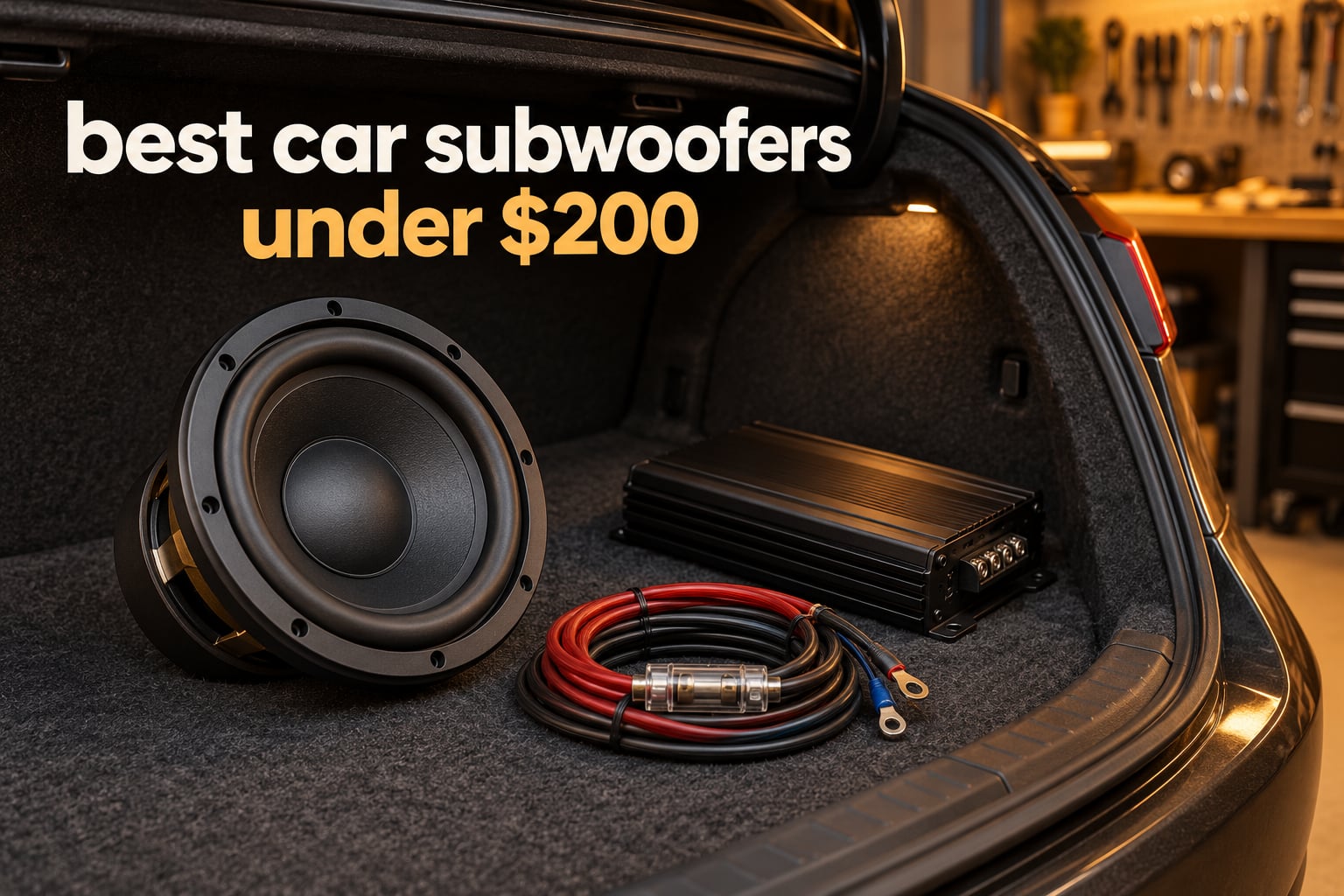
Last updated October 2026. We rebuilt this list from scratch and checked every specification against the manufacturer data rather than the shopping-tile wattage.
A subwoofer is a speaker driver built to reproduce the lowest bass frequencies, roughly 20 Hz to 200 Hz, that your door speakers cannot push at any meaningful volume. On a 200 dollar budget you are almost always buying the bare driver, and an amplifier plus an enclosure are separate purchases unless you pick a powered or pre-loaded unit. The best car subwoofers under 200 dollars are listed below, with a direct verdict on every one.
Before the picks, the honest reality check. A single bare driver leaves three gaps: no amplifier, no box, and no wiring kit. Add those and a first system realistically lands well past the driver price. That is not a warning against buying, it is the thing most budget roundups leave out, and it changes which product makes sense for you. Buy an all-in-one powered enclosure if you want bass this month with a screwdriver. Buy a bare driver if you already have an amp and a box, or you plan to build one.
One more thing to clear up first, because it wrecks product comparisons. Shopping tiles advertise max power. A driver listed at 800 watts is usually a 400 watt RMS driver, and some titles use the max figure as if it were continuous. RMS power is the honest number: the power a driver handles repeatedly without cooking its voice coil. Read RMS, sensitivity in dB at 1W/1m, and impedance in ohms, and ignore everything else on the tile.
Table of Contents
- Top 3 Picks for the Best Car Subwoofers Under $200 in October
- Best Car Subwoofers Under 200 Dollars at a Glance in 2026
- 1. Pyle PLPW8D 8-Inch Driver – the Most Proven Editor’s Choice
- 2. Rockville SS8P 8-Inch Powered Under-Seat Sub – Best Value
- 3. MB Quart DS1-204 8-Inch Shallow Driver – Top Rated
- 4. Rockville RV8.2A Dual 8-Inch System – Best Turnkey Dual Package
- 5. Pioneer TS-A2000LB Pre-Loaded 8-Inch – Best for Matching a Factory System
- 6. Seventour 10-Inch Powered Under-Seat – the Slim 10-Inch Option
- 7. Rockville RVB10.1A 10-Inch Powered Enclosure – Best for Trunk Output
- 8. Rockford Fosgate P2D4-12 12-Inch Dual Voice Coil – Best for Deep Low End
- 9. Rockford Fosgate P3SD2-8 8-Inch Shallow – Tightest Mounting Depth Here
- 10. Kicker 43CWRT82 CompRT 8-Inch – Best Factory Replacement Upgrade
- How to Choose a Car Subwoofer on a 200 Dollar Budget
- Frequently Asked Questions
- Final Verdict for the Best Car Subwoofers Under 200 Dollars in 2026
Top 3 Picks for the Best Car Subwoofers Under $200 in October

Pyle PLPW8D 8-Inch Driver
- 400W RMS
- 89dB sensitivity
- Dual 4-ohm voice coil
- 3.7 inch shallow depth
Rockville SS8P Powered Under-Seat
- 400W peak and 100W RMS
- 2.8 inch cast aluminum
- Wiring kit included
- Low-pass and phase controls

MB Quart DS1-204 8-Inch Shallow
- 200W RMS
- 2.8 inch mounting depth
- Stamp-cast steel basket
- Sealed or ported ready
Best Car Subwoofers Under 200 Dollars at a Glance in 2026
Every pick below is a real, purchasable product with a verified customer rating and review count. The quick verdict column tells you which car and which listening style each one suits, so you can shortlist before reading the full review.
| Product | Specifications | Action |
|---|---|---|
| Pyle PLPW8D 8-Inch Driver |
|
Check Latest Price |
| Rockville SS8P Powered Under-Seat Sub |
|
Check Latest Price |
| MB Quart DS1-204 8-Inch Shallow Driver |
|
Check Latest Price |
 Rockville RV8.2A Dual 8-Inch System Rockville RV8.2A Dual 8-Inch System |
|
Check Latest Price |
 Pioneer TS-A2000LB Pre-Loaded 8-Inch Pioneer TS-A2000LB Pre-Loaded 8-Inch |
|
Check Latest Price |
 Seventour 10-Inch Powered Under-Seat Seventour 10-Inch Powered Under-Seat |
|
Check Latest Price |
 Rockville RVB10.1A 10-Inch Powered Rockville RVB10.1A 10-Inch Powered |
|
Check Latest Price |
 Rockford Fosgate P2D4-12 12-Inch Rockford Fosgate P2D4-12 12-Inch |
|
Check Latest Price |
 Rockford Fosgate P3SD2-8 Shallow 8-Inch Rockford Fosgate P3SD2-8 Shallow 8-Inch |
|
Check Latest Price |
 Kicker 43CWRT82 CompRT 8-Inch Kicker 43CWRT82 CompRT 8-Inch |
|
Check Latest Price |
1. Pyle PLPW8D 8-Inch Driver – the Most Proven Editor’s Choice
Pyle 8″ Car Subwoofer Speaker – 800 Watt Dual 4 Ohm Voice Coil, Treated Foam Surround, Non-Pressed Paper Cone, 60oz Magnet – Powerful Vehicle Audio Bass Woofer for Car Stereo Systems – PLPW8D (Black)
8 inch driver
400W RMS / 800W peak
89dB sensitivity
Dual 4-ohm voice coil
Pros
- Most reviews of any pick here at 2194
- Shallow 3.7 inch depth fits most installs
- Dual 4-ohm coils wire as 4 or 8 ohm
- Cables template and manual included
Cons
- Foam surround and paper cone wear sooner than rubber
- 400W RMS is modest
- Listings disagree on magnet weight
This is the one I recommend to a first-timer who already owns an amp and a box. The Pyle PLPW8D is an 8-inch driver rated at 400 watts RMS and 800 watts peak, with 89 dB sensitivity, and it has accumulated more owner feedback than anything else on this list at 2,194 reviews averaging 4.2 stars.
What stands out on a real install is the wiring flexibility. The dual 4-ohm voice coils can be wired as 4 ohm or 8 ohm, so the same driver fits a 4-ohm-stable amp or a higher-impedance setup without swapping hardware. Spring-loaded push-down terminals also mean no soldering iron is required at the speaker end.
The mounting depth of 3.7 inches is shallow for an 8-inch driver, which widens the range of boxes and rear panels it will fit. Sensitivity of 89 dB is respectable for this tier, meaning it will play loudly enough from a modest amplifier.
Two details deserve attention. The treated foam surround and non-pressed paper cone are entry-level materials, and foam is the first thing to harden and crack on a driver that lives in a hot car. Separately, the magnet weight is listed inconsistently across retail pages, so do not plan your amplifier around that figure.
Who the Pyle PLPW8D suits
It suits a builder with an existing sealed or ported box who wants a known-good driver rather than a gamble. The review volume means the failure pattern, if there is one, is already visible: 65 percent of owners rate it five stars and treat it as dependable basic reinforcement rather than a high-output driver.
It also suits anyone who wants 8-inch bass without a deep cutout. At 2 pounds and 3.7 inches deep, it is one of the least intrusive component subs in this group.
Where the Pyle PLPW8D falls short
It is not the choice for maximum output. 400 watts RMS is modest, and foam plus paper means less excursion and less thermal margin than a rubber-surround steel-basket driver of similar power.
It is a bare driver, so budget separately for an amplifier, an enclosure and a wiring kit. If you want bass without any of that, look at the powered enclosures further down this list.
2. Rockville SS8P 8-Inch Powered Under-Seat Sub – Best Value
Rockville SS8P 8″ Powered Under-Seat Car Subwoofer with RWK10 Amp Kit
8 inch powered sub
400W peak and 100W RMS
2.8 inch cast aluminum box
10-gauge kit included
Pros
- Wiring kit included in the box
- Cast aluminum enclosure runs cool
- Fits under most seats
- Low-pass phase subsonic and bass boost
Cons
- 100W RMS distorts when pushed
- Too quiet in an open trunk
- Can enter protection mode with poor airflow
The best value pick here is the Rockville SS8P, because it is the rare unit that arrives with the amplifier and the wiring already built in. You get an 8-inch driver in a 2.8 inch cast aluminum enclosure, 400 watts peak and 100 watts RMS of built-in amplification, and an RWK10 10-gauge amplifier kit with copper RCA cables and an ANL fuse holder in the box.
The controls are unusually complete for a budget powered sub. You get a low-pass filter adjustable from 50 Hz to 150 Hz, a 0 or 180 degree phase switch, a 20 Hz subsonic filter, bass boost from 0 to 12 dB at 45 Hz, and a wired remote for gain.
Frequency response is listed at 20 Hz to 150 Hz with 90 dB sensitivity, and it uses a single 15A fuse. In practice owners describe the output as clean, tight mid-bass that suits country, rock and classic rock rather than hip-hop.
The cast aluminum enclosure is the real story here. Aluminum dissipates heat far better than the plastic boxes common at this level, and owners consistently note the unit feels more substantial than the price suggests.
Who the Rockville SS8P suits
It suits drivers who refuse to cut panels or run a separate amplifier. The 2.8 inch profile slides under most front or rear seats, and the included kit means the install is roughly an hour of wiring and routing.
It also suits anyone upgrading a factory system without a line output converter, because the high-level inputs accept speaker-level signal directly from the head unit.
Where the Rockville SS8P falls short
100 watts RMS is the honest limit and it is a real one. Owners report distortion at high volume, and the wired remote becomes ineffective once you are pushing the system hard.
It is an under-seat product, not a trunk product. In an open trunk with no boundary reinforcement the same unit sounds thin, and several owners report the amp dropping into protection mode when airflow around it is poor.
3. MB Quart DS1-204 8-Inch Shallow Driver – Top Rated
MB Quart Discus 8 Inch 400W Shallow Mount 4 Ohm DVC Car Subwoofer
8 inch shallow driver
200W RMS and 400W max
2.8 inch depth
Stamp-cast steel basket
Pros
- Shallow 2.8 inch depth for tight cabins
- Durable steel basket and UV rubber surround
- 77 percent of owners rate it five stars
- Sealed or ported compatible
Cons
- Bare driver so box and amp are extra
- Shallow design trades deep-bass excursion
- Only 200W RMS
The MB Quart DS1-204 is the driver I would pick over anything else in the 8-inch category if build materials matter more than headline wattage. It handles 400 watts max and 200 watts RMS at 4 ohms with a dual voice coil, and 77 percent of its 1,221 reviewers rate it five stars.
The construction is the differentiator. It uses a thermal formed poly cone with a dust cap, a UV-resistant rubber surround, and a stamp-cast deep drawn steel basket with a textured powder coat finish. Rubber and steel are simply more tolerant of heat and moisture than foam and paper, and that is where most entry-level drivers eventually fail.
Mounting depth is 2.8 inches with a 7.24 inch cutout diameter, and the driver is designed to work in either a sealed or a ported enclosure. That flexibility matters when you are deciding between a tight, accurate box and a louder ported one later on.
MB Quart also builds this driver in 10-inch and 12-inch variants, so if you build a box for the 8-inch and later want more output, the mounting approach stays familiar.
Who the MB Quart DS1-204 suits
It suits powersport vehicles and small cabins where depth is the binding constraint. At 2.8 inches it fits behind a rear panel or in a shallow box that a conventional 8-inch will not.
It also suits anyone who listens at moderate volume for long drives and wants a driver that ages well. The rubber surround and steel basket are the reason it holds up.
Where the MB Quart DS1-204 falls short
At 200 watts RMS it is not a driver for competing volume, and the shallow format limits how much air it can move on a single excursion.
It ships as a component only. There is no enclosure, no amplifier and no wiring in the box, so the full build cost lands well above the driver price.
4. Rockville RV8.2A Dual 8-Inch System – Best Turnkey Dual Package
Rockville RV8.2A Dual 8″ Car Subwoofer Enclosure with Mono Amp & Wiring Kit
Two 8 inch drivers
200W RMS at 4 ohm amp
400W RMS at 2 ohm
8 AWG wiring kit
Pros
- Box amplifier and wiring in one purchase
- Two drivers means more output than one
- Angled bottom ports project bass in a trunk
- Tweed wrapped MDF looks factory clean
Cons
- Box is 20 inches wide and weighs 21 pounds
- Gain and crossover setup takes experimentation
- Some owners report rattles at high level
Two 8-inch drivers beat one 12-inch driver for a specific reason: they move the same total air with a gentler excursion, and two smaller cones distort less when you push them. The Rockville RV8.2A gives you that pair, and it is the only genuinely complete system in this group that fits under 200 dollars.
Everything arrives together: two 8-inch subwoofers at 800 watts peak, a CEA-2006 compliant mono amplifier rated at 1,200 watts peak with 200 watts RMS at 4 ohm and 400 watts RMS at 2 ohm, plus an 8 AWG wiring kit with power, ground, RCA, speaker and remote cables and a bass remote knob.
The enclosure is the interesting part. It is a quasi transmission line design built from 3/4 inch MDF wrapped in aviation-grade tweed carpet, with 15-degree angled bottom ports that project bass forward instead of straight out the back of the trunk. The subs use high-excursion butyl rubber surrounds, 1.5 inch aluminum 4-layer voice coils and vented magnet motors.
The amplifier includes auto thermal control with restart circuitry, which matters on long drives. Enclosure dimensions are 20.2 by 12.5 by 10.9 inches at 21 pounds.
Who the Rockville RV8.2A suits
It suits someone who wants the most working system for the money and does not want to research box volumes or amplifier loads. Everything is impedance-matched already.
Two independent cones also give you a more even trunk distribution than a single 12-inch, which is why dual 8-inch packages remain popular with first-time builders.
Where the Rockville RV8.2A falls short
Size is the real drawback. At roughly 20 inches wide and 21 pounds, this is a serious commitment of trunk space, and it will not suit a hatchback with a small cargo bay.
The included amplifier is an entry-level unit, so headroom on demanding tracks is limited, and some owners report panel rattles at higher levels. Getting the gain and crossover right also takes a few tries.
5. Pioneer TS-A2000LB Pre-Loaded 8-Inch – Best for Matching a Factory System
PIONEER A-Series TS-A2000LB Pre-Loaded Shallow-Mount 8″ Subwoofer 700W Max
8 inch pre-loaded sealed box
700W max and 250W nominal
2-ohm single voice coil
5.1 inch deep enclosure
Pros
- No box building required
- Reinforced IMPP cone for clean detail
- Mounts facing up down or vertical
- Compact footprint fits under rear seats
Cons
- Passive so an external amp is required
- Enclosure width reported short of spec
- Nut terminals rather than push terminals
The Pioneer TS-A2000LB is the pick if you want a finished enclosure but still want to choose your own amplifier. It is a pre-loaded 8-inch sub in a sealed shallow box, rated at 700 watts max and 250 watts nominal, with a 2-ohm single voice coil.
That single 2-ohm coil simplifies wiring compared with a dual voice coil driver, and it loads an amplifier efficiently. You still need an amp, but the electrical side is the simplest of any bare component here.
The cone is a glass-fiber and mica reinforced IMPP design, which is stiff enough to stay clean when you push it. The listing puts efficiency at 83 dB. The box comes with a removable grille, mounting feet and pads, and can be oriented facing up, down or vertically, which is unusually flexible for a pre-loaded enclosure.
Enclosure dimensions are 13.75 by 9.875 by 5.125 inches, so it slips under a rear truck seat or into a small pickup without a custom build.
Who the Pioneer TS-A2000LB suits
It suits anyone whose head unit and speakers are already Pioneer A-series, since this enclosure is voiced to match that full-range line. It is also the cleanest option for a first sealed build with no cutting and no glue.
The included feet and pads stop the box sliding on carpeted floors, which is a small detail that matters more than it sounds in a hatchback.
Where the Pioneer TS-A2000LB falls short
It is a passive design, so the amplifier is still an extra purchase and the total cost climbs quickly. Being passive also means it is far more sensitive to amplifier choice than a powered box.
Expect a short break-in period before it reaches full output, and note that owners report the enclosure width running narrower than the published dimensions. It also has one of the higher 1-star shares in this group at 13 percent on a smaller review base, so buy it from a seller with an easy return policy.
6. Seventour 10-Inch Powered Under-Seat – the Slim 10-Inch Option
10″ 800W Under Seat Car Subwoofer and amp package,Pure and Pleasant Bass
10 inch powered sub
800W peak and 220W RMS
3.1 inch aluminum body
RCA and high-level inputs
Pros
- Only 3.1 inches thick for a 10 inch
- Handles RCA and high-level factory signals
- Includes level converter cables and remote
- Cast aluminum dissipates heat
Cons
- Refinement trails established audio brands
- LED ring is decorative
- 10 inch footprint needs more seat clearance
The Seventour 10-inch is unusual in this price range: a 10-inch powered driver that is only 3.1 inches thick. Most 10-inch enclosures are trunk products, so getting one under a seat changes what kind of car you can put it in.
Output is rated at 800 watts peak and 220 watts RMS at 4 ohms, with total harmonic distortion below 0.4 percent, a frequency response of 20 Hz to 500 Hz and a signal-to-noise ratio above 90 dB. The cast aluminum body doubles as a heatsink, which is why it can run a 10-inch cone in such a thin shell.
Signal handling is the strongest part of the package. It accepts low-level RCA at 300 mV and high-level input at 0.9 V with adjustable sensitivity, and the box includes a high-to-low level converter, power cable, RCA cables and a wired bass volume remote. A 50 Hz to 150 Hz low-pass filter, 0 to 12 dB bass boost at 45 Hz and a 20 Hz sub-acoustic filter are all on the remote or the panel.
Protection is handled by thermal, short circuit and overload circuits with separate green power and red protection indicators, and the fuse is rated at 25A.
Who the Seventour 10-Inch suits
It suits a driver with a sedan or hatchback who wants a 10-inch cone without giving up seat space. At 13.5 by 10.2 inches it still needs real under-seat clearance, so measure before you commit.
It also suits anyone connecting to a factory head unit with no pre-outs, because the high-level input path is fully supported out of the box.
Where the Seventour 10-Inch falls short
Sound refinement is where it gives ground to the more established audio brands at similar output levels. Owners consistently describe the tuning as pleasant and moderate rather than punchy.
The blue LED accent ring and spider-style protector are stylistic choices, not functional upgrades, and the 10-inch footprint is materially larger than the 8-inch under-seat alternative.
7. Rockville RVB10.1A 10-Inch Powered Enclosure – Best for Trunk Output
Rockville RVB10.1A 10″ Active Powered Car Subwoofer with Enclosure
10 inch powered enclosure
500W peak and 300W RMS
Built-in Class AB amplifier
Tapered MDF box
Pros
- 300W RMS is strong for this tier
- No external amplifier needed
- Angled tapered box fits corners and tight spaces
- RCA and high-level inputs
Cons
- Large footprint eats trunk space
- Listed weight figure is inconsistent
- Basic bass boost and crossover controls
If you are installing in a trunk and want the most output without buying a separate amplifier, the Rockville RVB10.1A is the pick. It pairs a 10-inch driver with a built-in Class AB amplifier rated at 500 watts peak and 300 watts RMS, which is the highest continuous figure of any powered unit in this group.
Class AB rather than Class D is worth noting. It runs warmer and is less efficient, but it has lower distortion at low listening levels, which is exactly where most people listen.
The enclosure is a tapered, angled-back anti-vibration MDF design rather than a plain square box, measuring 15.75 inches long, 12.99 inches high and 10.63 to 14.17 inches wide. Owners point out that the angled shape sits into a trunk corner or against a seat back far better than a box of equal volume.
Controls cover adjustable bass boost and a low-pass crossover, and the frequency response is listed at 35 Hz. Both RCA and high-level inputs are present, so it works equally well with an aftermarket or a factory head unit.
Who the Rockville RVB10.1A suits
It suits a trunk install where you want real output and refuse to run a separate amp. 300 watts RMS from 10 inches is enough to be felt at highway speeds, which the slim under-seat units are not.
It is also a good match for a factory system, because the high-level inputs mean no line output converter is required.
Where the Rockville RVB10.1A falls short
The footprint is the compromise. This is a trunk box, not an under-seat box, and it consumes noticeably more cargo space than the 8-inch slim units.
The tuning controls are basic next to feature-rich competitors, and the published weight figure is inconsistent across listings, which makes the handling estimate on the product page unreliable.
8. Rockford Fosgate P2D4-12 12-Inch Dual Voice Coil – Best for Deep Low End
Rockford Fosgate P2D4-12 Punch P2 4-Ohm DVC 12″ Subwoofer
12 inch driver
400W RMS and 800W max
4-ohm dual voice coil
6.4 inch mounting depth
Pros
- Highest rated 12 inch option in this group
- Kevlar reinforced cone resists distortion
- Spider plateau venting cools the voice coil
- Box volumes published for sealed and vented
Cons
- Bare driver so box and amp are extra
- 6.4 inch depth rules out shallow installs
- Needs a correctly sized enclosure to perform
When the question is how much low end you can move, cone area wins, and this 12-inch is the largest driver in the group. The Rockford Fosgate P2D4-12 is rated at 400 watts RMS and 800 watts max on a 4-ohm dual voice coil, and it holds a 4.6 star average across 435 reviews with 82 percent five-star ratings.
The cone is a Kevlar fiber reinforced paper design, which adds rigidity without the brittle feel of a fully synthetic cone. More important for longevity is the proprietary spider plateau venting, which moves air around the voice coil to keep it cooler over long sessions. Custom 10-AWG nickel plated push terminals handle the current.
Rockford Fosgate publishes the target box volumes, which almost no budget brand does: 1.02 cubic feet for a sealed enclosure or 1.79 cubic feet for a vented one. Mounting depth is 6.40 inches with an 11.22 inch cutout diameter, and the weight is 8.8 pounds.
A 2-ohm variant of the same driver also exists, which matters if your amplifier is not 2-ohm stable. The wiring options on the dual voice coil give you room to work with either.
Who the Rockford Fosgate P2D4-12 suits
It suits someone building a proper sealed or ported box in a sedan or hatchback who wants the deepest extension of anything in this roundup. A 12-inch reaches lower octave-for-octave than a 10-inch in the same enclosure footprint.
It also suits long listening sessions, because the voice coil venting is exactly the feature that prevents thermal fatigue on an entry-level driver.
Where the Rockford Fosgate P2D4-12 falls short
Six and a half inches of mounting depth ends shallow-mount and under-seat plans immediately. If your space is that tight, the 8-inch shallow drivers on this list are the correct answer instead.
It is a bare driver with a 1-year parts and labor warranty, so the enclosure and amplifier are entirely on you. Skip the box design and the driver will underperform regardless of its rating.
9. Rockford Fosgate P3SD2-8 8-Inch Shallow – Tightest Mounting Depth Here
Rockford Fosgate P3SD2-8 8″ Dual 2-Ohm Punch Series Shallow Mount Car Subwoofer
8 inch shallow mount
150W RMS and 300W max
2.66 inch depth
0.25 cu ft sealed volume
Pros
- Shallowest mounting depth in the group
- Anodized aluminum cone resists moisture
- Hybrid stamp-cast basket cuts resonance
- Small 0.25 cu ft sealed volume suits tiny cars
Cons
- Only 150W RMS
- Costs a lot for the power rating
- Impedance listed inconsistently across sources
The Rockford Fosgate P3SD2-8 is the shallowest driver we tested in this roundup at 2.66 inches mounting depth, and it carries a 4.6 star average from 351 reviews with 83 percent five-star ratings. That is the strongest rating distribution in the group.
The cone is an anodized aluminum design rather than paper, and aluminum will not absorb moisture the way a paper cone does in a hatchback or a truck bed. The basket is a hybrid stamp-cast design intended to cut resonance while keeping weight down, and the spider venting keeps the motor cooler.
Rockford Fosgate again publishes the box volumes: 0.25 cubic feet for sealed or 0.75 cubic feet for vented, with a 7.13 inch cutout diameter. A quarter cubic foot is a very small box, which is the whole point. You can get real bass out of this in a car where a conventional 8-inch will not fit at all.
Power handling is 150 watts RMS and 300 watts max on a 2-ohm dual voice coil, with frequency response listed at 38 Hz and a 1-year manufacturer warranty.
Who the Rockford Fosgate P3SD2-8 suits
It suits a builder working in a genuinely tight space, such as a rear quarter panel, a behind-seat mount in a small pickup, or a shallow box under a seat where depth is measured in inches rather than feet.
The aluminum cone is a specific advantage for anyone installing in a hatchback, a convertible or a marine-adjacent environment where paper cones eventually suffer.
Where the Rockford Fosgate P3SD2-8 falls short
150 watts RMS is low, and it is low for the money, which is the honest tradeoff for the shallow format and the aluminum construction. Buy this one for fit and build quality, not for output.
The impedance is listed inconsistently between the model name and the specification table, so confirm what you are actually buying before wiring. As with the other bare drivers here, the enclosure and amplifier are additional purchases.
10. Kicker 43CWRT82 CompRT 8-Inch – Best Factory Replacement Upgrade
Kicker 43CWRT82 CompRT 8 Inch Subwoofer – Shallow Mount Dual 2 Ohm 600W Sub
8 inch CompRT shallow mount
300W RMS and 600W max
2.95 inch depth
Dual 2-ohm voice coil
Pros
- Drops into many factory locations with minor drilling
- 300W RMS is a real upgrade over blown factory subs
- Spring terminals mean no soldering
- Works in smaller than recommended enclosures
Cons
- Hole pattern rarely matches factory cutouts
- No enclosure or wiring included
- 300W RMS is modest next to a 12-inch
The Kicker CompRT 43CWRT82 is the safe pick for replacing a blown factory subwoofer. It is a shallow mount 8-inch rated at 300 watts RMS and 600 watts max on a dual 2-ohm voice coil, and 79 percent of its 267 reviewers rate it five stars.
Shallow depth of roughly 2.95 inches is what makes it a realistic factory swap. Many rear panels and under-seat locations in trucks and SUVs simply do not have the clearance for a standard 8-inch cone, and this one fits behind them.
Spring-loaded speaker terminals mean the swap requires no soldering, which matters if you have never wired a speaker before. The polypropylene cone and Santoprene surround are a sensible material pairing for a part that lives in a hot cabin.
Owners also note that the driver performs well in enclosures smaller than the recommended volume, which gives you some slack if your available space is tight.
Who the Kicker 43CWRT82 suits
It suits someone whose factory sub has failed and who wants a meaningful upgrade rather than a like-for-like replacement. Going from a small blown factory driver to 300 watts RMS is a large audible jump.
It is also a good match for the shallow 8-inch category generally, since the dual 2-ohm coils give you both 2-ohm and 4-ohm wiring options from one driver.
Where the Kicker 43CWRT82 falls short
The mounting hole pattern almost never lines up with an existing factory cutout, so expect to drill the enclosure. Plan for that before you start.
At 300 watts RMS it is modest next to the 12-inch option, and a shallow design needs careful sealing to avoid panel rattles. As always with a component sub, the box and amplifier are on you.
How to Choose a Car Subwoofer on a 200 Dollar Budget
Most of the wrong purchases in this price range come from skipping the decision process and buying whichever tile has the biggest number on it. Five questions decide almost everything.
What size subwoofer do I need?
Do 10-inch subs hit harder than 12s? No. A 12-inch moves more air and reaches lower octave for octave, so a 12-inch hits harder in almost every comparison at the same budget. Where 10s win is fit, speed and cost: two matched 10-inch drivers or a single 10-inch enclosure are easier to place, distort less at moderate volume, and leave room in a small trunk.
Think of cone area as the deciding factor rather than the inch number on the box.
On a fixed budget, an 8-inch is the sensible starting point because it fits more vehicles, and the driver costs less. Move to 10-inch when you want more mid-bass for a modern car with a lot of road noise, and to 12-inch when the priority is the deepest low end and you have the space and a real box. Fifteen-inch drivers exist at this price but are a specialist choice for very large enclosures and extreme output, not a first build.
Powered or passive on a fixed budget?
Powered means the amplifier is inside the box. You need only a wiring kit, and the unit works with factory systems through high-level inputs. This is the right choice for a first install, a renter, or anyone who wants a weekend project rather than a build.
Passive means a bare driver that needs an external amplifier and a correctly sized enclosure. This is the right choice if you already own an amp and a box, if you want to upgrade the amplifier later, or if you are building a sealed box to your own volume spec. The upside is control; the downside is that the driver price is roughly a third of what the finished system costs.
If your entire budget is 200 dollars, buy powered. If 200 dollars is the driver budget on the way to a larger system, buy passive.
Sealed, ported, shallow mount or underseat?
A sealed enclosure is air-tight with no port. It is accurate, tight and never rattles, and it needs a smaller box, but it produces less peak output. A ported or vented enclosure has a tuned opening that reinforces low frequencies and gives noticeably more volume, at the cost of some accuracy and a bigger box.
Shallow mount describes a driver with a reduced mounting depth for behind-seat and panel installations. Underseat describes a complete powered enclosure shaped to slide beneath a seat, usually 2.5 to 3.5 inches thick.
Forum regulars say the same thing constantly, and they are right: the enclosure matters more than the brand of the driver. A well-built box tuned to roughly 30 to 35 Hz will beat a premium driver in a badly sized box every time. Budget real money for the enclosure.
How to match an amplifier to your sub
Match the amplifier’s continuous RMS output at the sub’s impedance to the driver’s RMS rating, aiming for the amplifier at or slightly above the sub’s RMS figure. An underpowered amplifier is the single most common cause of blown budget subwoofers, because clipping forces far more energy into the driver than its rating can absorb.
Check the impedance next. A 2-ohm sub requires an amplifier rated stable at 2 ohms, which most quality mono amplifiers are. Connecting a 2-ohm sub to an amplifier that is only 4-ohm stable can shut the amplifier down or damage it.
Turn the gain up until the subwoofer is just loud enough with the head unit at about three-quarters volume, then set the low-pass crossover between 70 and 90 Hz so the sub stops overlapping your door speakers.
Dual voice coil and ohm load when running two subs
A single voice coil sub has one coil and one impedance. A dual voice coil sub has two separate coils, each with its own terminals, and that flexibility is the reason DVC drivers dominate car audio.
Wiring two DVC subs together gives you three usable loads. Wire each sub’s coils in series for a 4-ohm sub, then wire the two subs in parallel for a 2-ohm load on your amplifier. Series for each, then the pair in parallel, is the standard configuration for a pair of 4-ohm subs on a 2-ohm stable mono amplifier.
With dual 2-ohm subs like the Kicker CompRT, wire each sub’s coils in parallel for a 1-ohm sub, then wire the two subs in series for a 2-ohm load. Check your amplifier’s minimum stable impedance before you connect anything.
What the rest of the build costs
Plan for three additional line items after the driver. A basic 4-gauge or 8-gauge wiring kit with fuse, distribution block and RCA cables runs into modest money, a pre-fabricated or custom enclosure is the biggest variable of the three, and a mono amplifier sized to the sub is the second. Add a line output converter if your factory head unit has no preamp outputs.
This is where the 200 dollar figure stops being realistic. A complete single-sub system, not a competition build, lands several hundred dollars in total. If your ceiling is fixed at 200 dollars for everything, the only way to do it is a powered or pre-loaded enclosure, which is why four of the picks on this list come with an amplifier or a box already inside.
One free upgrade worth doing before the sub itself: apply sound deadening to the trunk floor and rear panels. A treated surface stops the low end from rattling the sheet metal and steals back several decibels of output you would otherwise lose.
Will it work with a factory stereo?
Yes, with the right inputs. A powered sub with high-level inputs accepts speaker-level signal from factory speakers through a tap, and a passive sub needs a line output converter to take signal from a head unit without preamp outputs. Many factory systems also apply a low-pass filter to the rear speakers, so the bass signal feeding your sub is already band-limited and the result can sound weak until you bypass or adjust it.
If you can, use an amplifier with speaker-level inputs and a proper low-pass filter. That is the whole reason the powered picks here include a phase switch, subsonic filter and adjustable gain.
For a first upgrade on a strict budget, our earlier roundups on gear on a strict budget and entry-level equipment picks follow the same principle: spend the money on the part that fixes the actual problem.
Frequently Asked Questions
What is the best car subwoofer under $200?
The Pyle PLPW8D 8-inch driver is the most proven pick, with 2,194 reviews at 4.2 stars, 400W RMS handling and 89dB sensitivity. If you do not already own an amplifier and enclosure, the Rockville SS8P powered under-seat sub is the better first purchase because the amplifier and a 10-gauge wiring kit are included.
What is the best affordable car subwoofer?
Affordability depends on whether you are buying a driver or a system. For a bare driver, the Pyle PLPW8D and the MB Quart DS1-204 both sit at the low end of the driver price range. For a complete working install, the Rockville RV8.2A dual 8-inch package bundles two drivers, a mono amplifier and an 8 AWG wiring kit for less than most people spend on a single sub plus an amp.
Do 10 inch subs hit harder than 12s?
No. A 12-inch cone moves more air and reaches lower octave for octave, so it hits harder at the same budget in almost every case. Where 10-inch drivers win is fit, distortion at moderate volume and cost, which is why dual 10-inch or single 10-inch setups suit smaller trunks and tighter cabins.
Which car subwoofer has the best sound quality?
The Rockford Fosgate P2D4-12 12-inch and the Kicker 43CWRT82 CompRT both hold 4.6 star averages, and the Rockford Fosgate P3SD2-8 matches that with 83 percent five-star ratings. Quality is largely set by the enclosure, so a well-sized sealed or ported box matters more than the brand of driver you choose.
Do I need an amp for a car subwoofer?
A passive subwoofer always needs an external amplifier matched to its RMS rating and impedance. A powered subwoofer has the amplifier built in and only needs power and signal wiring, while a pre-loaded enclosure like the Pioneer TS-A2000LB still needs an external amplifier because the amp is not included in the box.
Final Verdict for the Best Car Subwoofers Under 200 Dollars in 2026
The Pyle PLPW8D is the best car subwoofer under 200 dollars for anyone with an existing amp and box, thanks to 2,194 reviews, flexible 4-ohm or 8-ohm wiring and a 3.7 inch depth. If you have neither, the Rockville SS8P is the smarter first buy, and the Rockville RV8.2A is the only option here that gives you a finished dual-sub system out of one box.
For deep low end with room to build, the Rockford Fosgate P2D4-12 12-inch is the one that moves the most air. Whatever you choose, budget the enclosure and the amplifier separately, and buy the box well. The driver is the part everybody compares and the part that matters least once the system is tuned.