
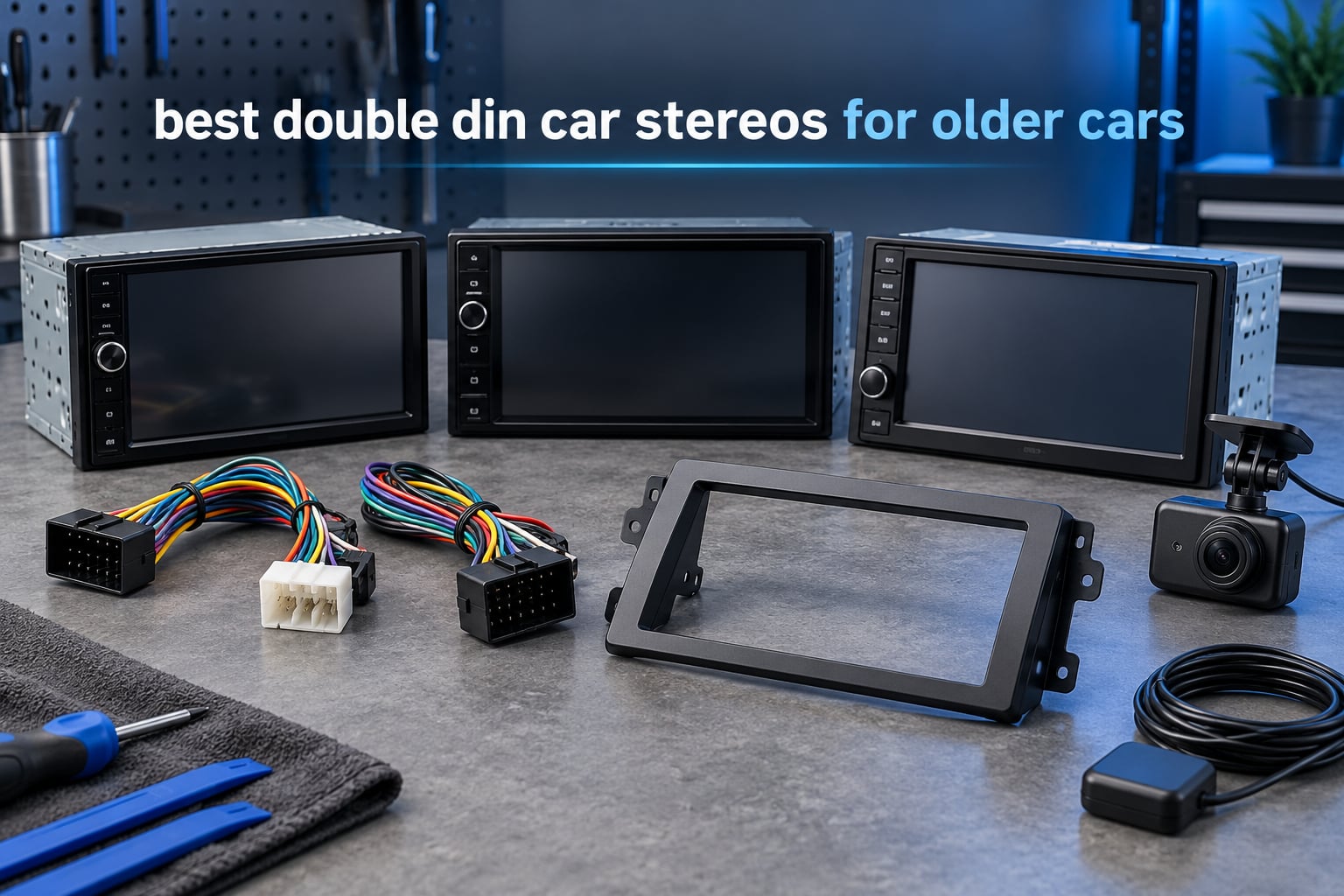
A double-DIN car stereo is an aftermarket head unit built to fill a standard 180mm x 100mm dash opening, roughly 7 by 4 inches, which is exactly twice the height of a single-DIN opening. That extra height is what lets manufacturers fit a proper touchscreen, a stronger internal amplifier and more preamp outputs into a car that was never designed for them.
That matters most in cars built before the mid-2000s. A 1998 sedan or a 2003 pickup usually left the factory with a cassette deck, a CD player or a single-line radio, none of which pair with a phone. Swapping in a double-DIN head unit is the largest daily-driving improvement most owners of an older car will ever make, and it costs a fraction of replacing a whole dashboard.
We compared ten current double-DIN head units and sorted them for the awkward reality of an older car: chassis depth, whether physical knobs survive, what preamp voltage is available for a future amplifier, and whether the dash trim will go back on. We also weighed what each receiver leaves out, because features that matter in a new car often do nothing in a 20-year-old one.
One note before you start: a head unit is only half of the job. The other half is the dash kit, the wiring harness, the antenna adapter and, in most cases, a steering wheel control adapter. We cover all of that further down.
Table of Contents
- Top 3 Picks for the Best Double DIN Car Stereo for Older Cars in 2026
- All 10 Double DIN Head Units Side by Side in October
- 1. Pioneer MVH-S622BS – the head unit older drivers actually want
- 2. PLZ 7 inch Wireless Double DIN – budget wireless CarPlay
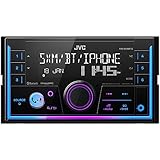
- 3. JVC KW-X840BTS – best sound per dollar
- 4. Pioneer DMH-130BT – short chassis for tight dashboards
- 5. Kenwood DPX305MBT – clear calls in a loud old cabin
- 6. JVC KW-SX88BT – real buttons and a detachable faceplate
- 7. Planet Audio P9900CPA – voice control on a smaller budget
- 8. JVC KW-M560BT – built for a subwoofer later
- 9. Pioneer DMH-1600NEX – the radio tuner buff’s pick
- 10. BOSS Audio Systems 850BRGB – keeps a CD and DVD deck
- What double-DIN actually means (and what it does not)
- How to check whether a double-DIN head unit fits your older car
- What you need to install one (and what usually is not included)
- Frequently Asked Questions
- The bottom line for older-car audio upgrades
Top 3 Picks for the Best Double DIN Car Stereo for Older Cars in 2026

Pioneer MVH-S622BS
- Mechanical volume knob
- 4V front rear and sub pre-outs
- 31-band EQ in the app

PLZ 7 inch Wireless
- Wireless CarPlay and Android Auto
- 7 inch IPS touchscreen
- Two subwoofer outputs

Our overall pick, the Pioneer MVH-S622BS, is the rare budget receiver that still gives you a real rotary knob for volume and 4V pre-outs for an amplifier down the road. It carries a 4.5 rating across 836 reviews, which is the strongest balance of rating and review depth in this group.
The PLZ is the value pick if wireless CarPlay matters most and you want a large screen. The BOSS 850BRGB is the only receiver here with a working DVD and CD mechanism, which still matters to a lot of owners of older cars.
All 10 Double DIN Head Units Side by Side in October
| Product | Specifications | Action |
|---|---|---|
| Pioneer MVH-S622BS |
|
Check Latest Price |
| PLZ 7 inch Wireless Double DIN |
|
Check Latest Price |
 JVC KW-X840BTS JVC KW-X840BTS |
|
Check Latest Price |
 Pioneer DMH-130BT Pioneer DMH-130BT |
|
Check Latest Price |
 Kenwood DPX305MBT Kenwood DPX305MBT |
|
Check Latest Price |
 JVC KW-SX88BT JVC KW-SX88BT |
|
Check Latest Price |
 Planet Audio P9900CPA Planet Audio P9900CPA |
|
Check Latest Price |
 JVC KW-M560BT JVC KW-M560BT |
|
Check Latest Price |
 Pioneer DMH-1600NEX Pioneer DMH-1600NEX |
|
Check Latest Price |
| BOSS Audio Systems 850BRGB |
|
Check Latest Price |
Read the table for the short version. The longer sections below explain why each receiver earns its place, and where it will disappoint you.
1. Pioneer MVH-S622BS – the head unit older drivers actually want
Pioneer MVH-S622BS Double Din Car Stereo with Bluetooth, USB
Mechless single-DIN chassis
50W x 4 MOSFET amplifier
4V front rear and sub pre-outs
13-band EQ with FLAC playback
Pros
- Real rotary volume knob
- 31-band EQ and time alignment in the Smart Sync app
- 4V pre-outs ready for an amplifier
- Bluetooth keeps working without the app
- SiriusXM ready with variable color illumination
Cons
- Display stays bright at night on the lowest setting
- No mounting hardware in the box
- No touchscreen and no CarPlay
This is the receiver we ended up recommending to friends. It has no touchscreen, which sounds like a compromise in 2026 and feels like the opposite once you drive with it for a week.
The volume control is a genuine rotary knob with a detent, and track skipping and source changes sit on real buttons either side of it. On a capacitive screen you swipe with a cold hand, you glance down to confirm what you hit, and you take your eyes off the road doing it.
Sound tuning is where Pioneer still leads at this end of the market. The Smart Sync app exposes a 31-band EQ, per-channel level control and time alignment, and those settings survive in the receiver once you save them, so the phone is not required every time you start the car.
The amplifier section is a 50W x 4 MOSFET design rated at 4 volts on the front, rear and subwoofer pre-outs. That 4V figure is the number to care about if your car keeps a factory amplifier or if you plan to add one later, because a 2V signal has to be turned up louder to reach the same end result, and that is where distortion enters.
Who this double-DIN head unit suits
It suits an older car with a shallow dashboard, an owner who drives often enough to care about call quality, and anyone planning an amplifier or a subwoofer in a second stage. FLAC playback and a variable illumination colour let it blend into a dark 1990s interior instead of fighting it.
Bluetooth here is the older, simpler version. Pair once and the phone connects on its own, and streaming keeps working even if the Smart Sync app is closed, which removes the single most common complaint about app-dependent receivers.
Who should skip it
Skip it if navigation is the reason you are upgrading. This unit has no CarPlay or Android Auto, no touchscreen and no video input, so you are back to phone navigation and a separate mount.
Two smaller warnings. The display is bright enough that owners report it staying harsh at night even on the lowest setting, and no mounting hardware is included, so budget for a dash kit and screws before the box arrives. Overall it holds a 4.5 rating across 836 reviews.
2. PLZ 7 inch Wireless Double DIN – budget wireless CarPlay
PLZ 7″ Wireless Double Din Car Stereo Apple Carplay Radio Screen for Car Audio Receivers, Bluetooth 5.3 Car Play Android Auto Touchscreen, 240W 4.2 CHN 2 Subwoofers Outputs, Backup Camera, SWC, FM/AM
7 inch IPS touchscreen at 1024x600
Wireless and wired CarPlay plus Android Auto
240W 4.2 channel output with two subwoofer outputs
Bluetooth 5.3 and backup camera included
Pros
- Wireless CarPlay and Android Auto on a budget
- Large 7 inch IPS touchscreen
- Built-in DSP with 10-band EQ
- Two subwoofer outputs
- Backup camera and steering wheel control support
Cons
- Call and navigation audio can sound thin
- Wireless Android Auto needs Android 11 or newer
- Occasional Bluetooth dropouts reported
Almost every other touchscreen receiver in this list needs a cable. This one runs CarPlay and Android Auto over Wi-Fi, which means no USB port fighting with a phone charger in a 1990s centre console.
The 7 inch IPS panel runs at 1024×600 and stays readable in direct sun, and the minimum opening quoted is 6.69 by 3.81 inches, so it drops into most standard double-DIN cutouts without trimming. Bluetooth 5.3 uses a separate module and an external antenna, which is the part that usually causes dropout in cheaper units.
On the audio side there is a built-in DSP driving a 4.2 channel configuration, a 10-band EQ and two dedicated subwoofer outputs rather than one. Two sub outputs is unusual in this class and it means a future amplifier install does not need a splitter.
The backup camera is included in the box, and steering wheel control support is built in, so the wiring side of the install is closer to finished out of the package than most rivals.
Who this double-DIN head unit suits
It suits a driver who wants the phone in charge of navigation and messages and does not want to replumb the console to get there. Support staff have also been singled out as responsive on firmware updates, which matters on a brand most buyers will not have heard of.
At 4 stars from more than 2200 reviews, it is the most examined receiver in this list, so most of the surprises are already documented.
Who should skip it
Skip it if call quality is your top priority. Owners report that microphone audio on calls and navigation prompts is the weak point on this receiver, which is odd given the separate Bluetooth module.
Also check your phone. Wireless Android Auto needs Android 11 or later, and some users see the backup camera input drop a no signal message intermittently. A 240W headline figure is peak output, not clean RMS, so expect to add an amplifier later rather than lean on the internal amp.
3. JVC KW-X840BTS – best sound per dollar
JVC KW-X840BTS Bluetooth Car Stereo Receiver with USB Port – AM/FM Radio, MP3 Player, Amazon Alexa Enabled – 1.5-line display – Double DIN – 13-Band EQ (Black)
Single-DIN chassis that fits a double-DIN opening
13-band EQ with digital time alignment
K2 technology and Volume Link EQ
6-channel preamp outputs at 2.5V
Pros
- Highest rated receiver in this group
- Single-DIN chassis fits tight old dashboards
- 13-band EQ with digital time alignment
- 2.5V pre-outs across six channels
- Volume Link EQ fights road noise
Cons
- No touchscreen at all
- Display is hard to read in bright sun
- Microphone quality is mediocre
This is the highest rated receiver here at 4.6 stars, and it wins on a detail most roundups skip: it is a single-DIN chassis that fits a single-DIN or double-DIN opening. That solves the fitment problem in older cars that never had a tall centre slot.
Because the chassis is 178 by 100 by 100mm, it can slide into openings that a true double-DIN faceplate would never clear. On a car with a narrow centre stack, that single spec can be the difference between a weekend install and a trimmed dashboard.
Sound is the priority. There is a 13-band EQ with digital time alignment, JVC K2 technology for digital sources and a Volume Link EQ setting that lifts lower frequencies to counter road noise, which is a genuinely useful control in an old car with thin doors and a loud cabin.
The preamp section is the best specified in this group relative to cost: six channels at 2.5V covering front, rear and subwoofer. Streaming DJ lets you pair up to five Bluetooth devices and flip between them, which suits a household that shares a car.
Who this double-DIN head unit suits
It suits an older car with a cramped or non-standard opening, and a driver who cares more about how the music sounds than about having a screen. The front USB port charges at 1.5A and there is a front AUX input, both unusual in a mechless receiver.
If your car still runs a factory amplifier, six 2.5V pre-outs give you room to feed it or to add your own without replacing the head unit again.
Who should skip it
Skip it if you want CarPlay, Android Auto or any kind of navigation screen. There is no touchscreen, and the 1.5-line display is limited to text and simple graphics, with owners reporting it is difficult to read in bright sunlight.
The microphone is also the weakest part of the package, so expect to raise call volume or use an external mic if you take long calls while driving. Alexa works through the JVC skill rather than being built in, so it needs your phone.
4. Pioneer DMH-130BT – short chassis for tight dashboards
Pioneer DMH-130BT 6.8″ Capacitive Touchscreen Double Din Car Stereo
6.8 inch capacitive touchscreen
4.375 inch short chassis depth
Amazon Alexa through the Vozsis app
Backup camera input and FLAC playback
Pros
- Very short chassis reaches into crowded dashboards
- 6.8 inch capacitive touchscreen
- Alexa through the Vozsis app
- Backup camera input
- Five display colours and custom background
Cons
- No CD or DVD mechanism
- Some units show screen flashing over time
- Steering wheel control input is not universal
Chassis depth is the spec that quietly decides whether a receiver fits an older dashboard, and this one is only 4.375 inches deep. Deep back panels are the reason many installs end with a display that sits proud of the trim.
The screen is a 6.8 inch capacitive panel with a 50W x 4 MOSFET amplifier behind it and a 13-band EQ. Pioneer also lets you upload a background image and pick from five display colours, which is how you stop a modern screen looking like an intrusion in a beige interior.
Voice control runs through Amazon Alexa on the Pioneer Vozsis app, so no phone app is needed on the road once it is set up. There is a dedicated backup camera input, USB and AUX inputs and FLAC playback from a USB stick.
Alexa works over the phone rather than through a cloud connection, which means it needs service but not a data plan.
Who this double-DIN head unit suits
It suits a driver replacing a factory screen in a car with a cramped centre stack, where a full-depth receiver would foul the climate control linkage or the ducting behind the dash. The shallow body also makes the wiring job less painful.
For anyone who wants a big screen and modern voice control but is not ready to run a cable every time they start the car, this is a sensible middle ground.
Who should skip it
Skip it if you want a navigation app on the dash. There is no CarPlay or Android Auto, so phone maps still mean a phone mount, and video or map screens on the unit itself need a brake light bypass wire.
Two more cautions. Some owners report screen flashing developing over time on units they have owned a while, and the steering wheel control input does not work on every vehicle without a matching adapter. It holds a 4.3 rating from 553 reviews.
5. Kenwood DPX305MBT – clear calls in a loud old cabin
Kenwood DPX305MBT Double DIN in-Dash Digital Media Receiver with Bluetooth (Does not Play CDs) | Mechless Car Stereo Receiver | Amazon Alexa Ready – Black
Mechless shallow-chassis receiver
Bluetooth with adjustable microphone gain
13-band EQ with digital time alignment
Subwoofer RCA outputs and Alexa ready
Pros
- Microphone gain control cleans up calls in a loud car
- Shallow chassis suits older dashboards
- 13-band EQ with time alignment
- Subwoofer RCA outputs
- Variable colour illumination and a dedicated Bluetooth button
Cons
- Bluetooth can take up to 20 seconds to connect
- EQ tuning is less refined than Pioneer
- Display styling looks dated
Old cars are loud. Wind noise through a thin windscreen, a tired exhaust and no acoustic carpeting will eat a phone call, and this Kenwood addresses that directly with adjustable Bluetooth microphone gain rather than leaving you with the factory setting.
The rest is a sensible mechless package: a shallow chassis that will not fight the dash, 13-band EQ with digital time alignment, subwoofer RCA outputs and variable colour illumination so the display can match an aged interior light.
Two phones can stay connected at once, so if the car is shared between a partner and a teenager nobody has to forget to unpair before handing over the keys. Pandora and Spotify are supported alongside USB playback of MPEG, WAV and WMA files.
Output is rated at 50W x 4 peak with a 5.1 channel configuration, which is enough for most factory speaker sets without an amplifier.
Who this double-DIN head unit suits
It suits a daily driver who takes calls on the move and drives something with real road noise, and anyone who wants two phone connections without thinking about them. A Bluetooth direct access button means pairing is one press rather than a menu dive.
The shallow body is a genuine advantage in older dashboards where space behind the faceplate is tight.
Who should skip it
Skip it if you are picky about tuning. Owners comparing it directly with Pioneer units describe the EQ result as noticeably less refined, and the 13-band controls do less work for the effort.
There is also a reported connection delay of up to 20 seconds on some phones, which is long enough to notice at every start. The display styling reads as late 1990s to some eyes, and at 4.5 stars from 167 reviews the owner base here is the thinnest in the group, so buy it for the mic gain specifically rather than on brand reputation.
6. JVC KW-SX88BT – real buttons and a detachable faceplate
JVC KW-SX88BT Bluetooth Double DIN Car Stereo, 200W Digital Stereo Receiver, AM/FM Radio, Dual Phone Connection, 13-Band EQ, 1.5A USB & AUX Inputs, Custom Color Illumination, Shallow Chassis
LCD display with detachable faceplate
3.94 inch shallow chassis depth
13-band EQ with digital time alignment
50W x 4 peak power and 2.5V pre-outs
Pros
- Every function on a real button or knob
- Shallow 3.94 inch chassis
- Detachable faceplate deters theft
- Dual phone Bluetooth connection
- Fast 1.5A USB charging
Cons
- No touchscreen and no CarPlay
- Only two channel preamp outputs
- No backup camera input
This is the anti-touchscreen pick, and for some older drivers it is the only sensible answer. Everything on this receiver is operated by a knob or a button, including a rotary volume control you can find without looking.
It is also the shallowest double-DIN in the group at 3.94 inches, which makes it forgiving in dashboards that are already crowded behind the opening.
The LCD has a detachable faceplate, and the unit is designed to be carried with you rather than pried out of the dash. On a car parked on a street, that alone removes the argument that a modern screen is an invitation.
Audio is handled by a 13-band EQ with digital time alignment and JVC K2 technology, with dual phone Bluetooth so two drivers can stay connected. Custom colour illumination is adjustable to match an original dashboard.
Who this double-DIN head unit suits
It suits a driver who dislikes touch controls, owns a car that spends its life parked in view of a car park, and wants Bluetooth calling without giving up physical buttons. The 3.94 inch depth is the friendliest fitment in this roundup.
It also suits anyone who will never use phone navigation on the dash and just wants calls, radio and streaming.
Who should skip it
Skip it if you want CarPlay, Android Auto or a backup camera, because none of those are supported here. The two-channel preamp outputs at 2.5V also limit future expansion, with separate front and rear control rather than a dedicated subwoofer feed.
Format support is narrower than the Pioneer units, covering MP3, WMA, WAV and AAC. And with no touchscreen, this is a car audio upgrade rather than a car technology upgrade, which is exactly what some owners want and what others find uninspiring.
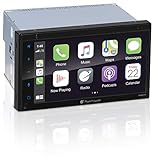
7. Planet Audio P9900CPA – voice control on a smaller budget
Planet Audio P9900CPA Car Stereo – Wireless CarPlay Android Auto, Double-Din, 6.75 Inch Touchscreen, Bluetooth, No DVD CD Player, Radio Receiver
6.75 inch touchscreen
Wireless Apple CarPlay and Android Auto
Front rear and subwoofer preamp outputs
Backup camera input and steering wheel control ready
Pros
- Wireless CarPlay and Android Auto at this tier
- Large 6.75 inch touchscreen
- Separate front rear and subwoofer outputs
- Backup camera input
- Three year warranty through Amazon
Cons
- Touchscreen sometimes unresponsive
- Wireless connection can drop or freeze
- Microphone quality is poor
If your budget will not stretch to the premium wireless units, this is where wireless CarPlay and Android Auto stops being aspirational. The 6.75 inch touchscreen runs both phone platforms over Wi-Fi, with Siri and Google Assistant built into the button.
The preamp section covers front, rear and subwoofer independently, which is more than several cheaper touchscreens offer, and there is a backup camera input ready for a camera you add later.
Steering wheel control is supported, but through a separate adapter that is not included, so factor that into the install plan. A three year warranty is available through Amazon, which is longer than the one year most brands in this group offer.
App support covers WhatsApp, Spotify, Pandora, iHeartRadio, Google Maps and Waze through the phone link rather than through a built-in app.
Who this double-DIN head unit suits
It suits a driver on a tight budget who still wants cable-free navigation, and anyone planning to add a backup camera to an older car without replacing the head unit again.
The three year warranty is a real differentiator for a brand most people only know from subwoofers, and it covers the receiver rather than just parts.
Who should skip it
Skip it if you are installing this and expecting it to be the finished article. Owners report the touchscreen being intermittently unresponsive, units freezing or restarting, and wireless connections dropping in exactly the conditions you would want them to work, in a moving car.
The microphone is poor for hands-free calling, and a terms prompt appears on startup often enough to annoy. Support can also be hard to reach, so buy it for the feature list and the warranty rather than for aftercare.
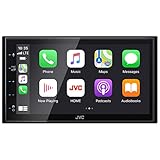
8. JVC KW-M560BT – built for a subwoofer later
JVC KW-M560BT Apple CarPlay Android Auto Multimedia Player w/ 6.8″ Capacitive Touchscreen, Bluetooth Audio and Hands Free Calling, MP3 Player, Double DIN, 13-Band EQ, SiriusXM, AM/FM Car Radio
6.8 inch capacitive touchscreen
Wired Apple CarPlay and Android Auto
6-channel 2V preamp outputs
Subwoofer level, phase and crossover controls
Pros
- Full subwoofer level phase and crossover controls
- 6-channel preamp outputs for future amps
- Wired CarPlay connects reliably
- Backup camera input with parking guides
- SiriusXM ready
Cons
- Wired phone connection only
- No physical volume knob at all
- Touchscreen lag on some functions
- Firmware updates have bricked units for some owners
This is the receiver to buy if you already know a subwoofer is coming. Most budget head units expose a subwoofer level; this one gives you level, phase and crossover control from the unit, plus six preamp outputs to feed a separate amplifier.
Apple CarPlay and Android Auto run over a wired USB connection rather than wirelessly. That sounds like a downgrade against the units above, but owners of this model describe the wired link as the most reliable phone integration they have had.
The 6.8 inch capacitive touchscreen is paired with a 13-band EQ and digital time alignment, and there is a rear video output on RCA if you ever want a second screen. SiriusXM readiness is there for a long-distance drive.
The backup camera input draws parking guides on the screen, which saves fitting a camera with guidelines of its own.
Who this double-DIN head unit suits
It suits a driver on a phone that charges and connects over the same cable and who would rather have a stable link than a wireless one. It also suits anyone building a system in stages, starting with the head unit and adding an amplifier and sub later.
At 21W RMS per channel the internal amp is modest, which is another reason the pre-outs matter.
Who should skip it
Skip it if you dislike having no physical controls whatsoever. There is no volume knob at all on this receiver, and every function including volume lives on the screen.
Owners also report touchscreen lag on some functions, a clock that does not always keep correct time, and gaps when the unit sits in certain dash kits. Most seriously, some owners report firmware updates leaving the unit unusable, so leave the software alone once it is working, and check the fit in your chosen dash kit before final assembly.
9. Pioneer DMH-1600NEX – the radio tuner buff’s pick
Pioneer DMH-1600NEX 6.8″ Capacitive Touchscreen Double Din Car Stereo
6.8 inch WVGA capacitive touchscreen
Wired Apple CarPlay and Android Auto
Backup camera input with parking guides
Front rear and subwoofer RCA pre-outs
Pros
- SuperTuner IIID pulls in weak stations cleanly
- External microphone improves call clarity
- Backup camera input draws parking guides
- Front rear and sub RCA pre-outs
- Channel level control for balance
Cons
- Wired phone connection only
- Needs a data transfer USB cable
- All touchscreen controls
- Screen glare in bright light
The case for this receiver is reception. Pioneer SuperTuner IIID is tuned for weak signals, and in an older car with a tired antenna mast or a long drive home through countryside, that is a real advantage over receivers chasing headline features.
The 6.8 inch WVGA capacitive touchscreen handles wired Apple CarPlay and Android Auto, and the phone connection runs over USB Type-A rather than the charge-only cables that cause half of all CarPlay problems.
An external microphone is included, which matters more in a cabin that rattles than it does in a quiet new car, and front, rear and subwoofer RCA pre-outs are all present for a later amplifier.
There are six subwoofer settings for bass tuning, SiriusXM readiness, and a backup camera input that displays parking guidelines.
Who this double-DIN head unit suits
It suits a long-distance driver who cares about radio reception and about being heard clearly on calls, and anyone who wants a head unit that will still support an external amplifier later without being replaced.
The external mic and the 13-band EQ with presets make it a good match for a car with a factory amplifier and door speakers worth keeping.
Who should skip it
Skip it if you want wireless phone integration, since CarPlay and Android Auto are wired only. Make sure you have a data transfer USB cable, because a charge-only cable will not carry the phone link and the problem usually looks like a faulty head unit.
Everything is operated by touch with no physical buttons or knob, the screen catches glare in direct sun, and the 13-band EQ is simpler than the 31-band app tuning on the Pioneer at number one. Steering wheel integration also needs a specific adapter on some vehicles. At 4.1 stars from 143 reviews, it is the least proven receiver here.
10. BOSS Audio Systems 850BRGB – keeps a CD and DVD deck
BOSS Audio Systems 850BRGB Double DIN Bluetooth Car Stereo, USB, DVD, AM/FM
Double-DIN chassis with a working DVD and CD player
Bluetooth with push-to-talk voice control
80W x 4 max power with three preamp outputs
Remote control and detachable faceplate included
Pros
- Only receiver here with a working CD and DVD mechanism
- Very low cost for that feature
- Remote and detachable faceplate included
- Three preamp outputs for an amplifier
- Custom colour illumination
Cons
- Volume knob often misaligned and rubs
- Volume resets high on startup
- Steering wheel controls are not compatible
- Some owners report units failing within weeks
Almost every head unit on this list has given up on discs. This one has not, and for an owner with a car full of CD bootlegs or a collection that has not been transferred to a phone, that is the feature that decides the purchase.
Bluetooth is included with a push-to-talk button for Siri and Google Assistant, and there is a detachable faceplate plus a remote control in the box, which is more than most rivals at any price.
On paper the power figure is the biggest here at 320W total, split across four channels, with front, rear and subwoofer preamp outputs for a future amplifier. The manufacturer recommends an external amplifier for the best result, which is honest advice.
The body is 7.1 inches deep, the deepest in this group, so measure your dashboard cavity before committing.
Who this double-DIN head unit suits
It suits an older car that still gets driven to shows and auctions where discs matter, and anyone who wants remote control and a removable faceplate on the most affordable receiver here.
Bluetooth calling and streaming are covered, and the multi-colour illumination helps the unit blend into an aged dashboard better than a glowing touchscreen would.
Who should skip it
Skip it if reliability matters more than disc playback. Owners report the volume knob sitting misaligned and rubbing, the volume level resetting high every time the car starts, and a poor microphone for calls. Some units have failed within weeks, and there is no brightness control on the display.
Steering wheel controls are not compatible with this receiver at all, so if your car has them you will either lose them or need to keep them dormant. If your priority is a modern double-DIN head unit for an older car, spend the extra and take one of the units above instead.
What double-DIN actually means (and what it does not)
Double-DIN is a physical standard, not a quality tier. The opening in the dashboard is 180mm wide by 100mm tall, and a double-DIN head unit is built to fill it, sitting in the same hole the factory radio came out of.
A single-DIN unit is half that height, at 180mm by 50mm. Some people use the terms loosely and call any large screen a double-DIN radio, which is where a lot of confusion online comes from. Check the chassis dimensions, not the marketing name.
What the standard guarantees is that the chassis fits the opening. What it does not guarantee is that your dashboard trim goes back on afterwards, that your existing wiring connects, or that the display sits flush with the surrounding panel. Those three things are decided by the dash kit, the wiring harness and the depth of the cavity behind the opening.
Two other terms cause trouble. A mechless receiver has no disc mechanism at all, which is now the norm and usually the right choice, since almost nobody plays discs. A floating display is a screen mounted on a separate bracket in front of the chassis, which gives a bigger screen for the same opening but adds depth and movement that some older dashboards cannot accept.
Preamp voltage is the last term worth learning. A 2V pre-out is the older standard; 4V or more gives an amplifier more signal to work with, which matters if your car keeps a factory amplifier or if you plan to add one later. Check it before you buy, because you cannot add it afterwards.
How to check whether a double-DIN head unit fits your older car
Measure before you buy, not after the box arrives. This takes ten minutes with a tape measure and it is the step that separates a clean install from a trimmed dashboard.
Measure the opening itself. The faceplate has to cover roughly 180mm by 100mm. Take the measurement at the top and the bottom, because dash openings in older cars are rarely perfectly rectangular.
Measure the depth behind the faceplate. A standard double-DIN chassis needs around 170mm of clearance, and some vehicles need more. Anything deeper than that means trimming or choosing a short-chassis unit such as the Pioneer DMH-130BT or the JVC KW-X840BTS, whose single-DIN body fits a double-DIN opening.
Check what is in the way. Behind the opening you will usually find the climate control cable, a wiper stalk loom or a set of air ducts. Anything that moves when you select or turn something means the depth available is shorter than the cavity looks.
Identify your opening type. If your car has a single-DIN or 1.5 DIN opening, a full double-DIN faceplate will not sit correctly, and a single-DIN mechless chassis plus a filling plate is the cleaner answer than trimming.
If the trim will not go back on after the new receiver is fitted, you have three options, in order of preference. Buy the correct vehicle-specific dash kit for your year, make and model, which is designed to fill the gap left by a wider unit. Then consider a facia or trim ring to cover the seam. Only then consider modifying the original trim, which usually means cutting it and cannot be undone.
On a car with a genuinely original interior, keeping the factory faceplate and hiding a modern system behind it is a common approach, and enthusiasts building 1980s and 1990s cars have recommended period-appropriate styling for exactly this reason. If the rest of the cabin is original, a modern glowing screen is the part that gives the project away.
Whatever you drive, the same principle applies to how you protect the rest of the cabin. We wrote about leather car seat covers for cars separately if seats are part of the refresh, and convertible car seats that fit small cars is worth a look if passengers are the priority rather than the dashboard.
What you need to install one (and what usually is not included)
A head unit in a box is about half of an install. In an older car you will nearly always need the following five items, and none of them are included in the receiver carton.
Dash kit. A vehicle-specific bracket and trim plate that holds the new receiver and fills the gap around it. This is the single item that decides whether the finished job looks factory or homemade. Many receivers, including the Pioneer MVH-S622BS, ship with no mounting hardware at all.
Wiring harness adapter. A plug-in harness that converts your car’s factory connector into a standard receiver harness, with the colours already matched. It also usually carries the ignition-on sense wire and the power antenna trigger. A bare adapter with loose wires will not plug in properly.
Antenna adapter. Needed when the new receiver has a different antenna socket than the one your factory radio used. It is a small part and it is the reason some installs end with no radio reception at all.
Steering wheel control adapter. This is where older cars get complicated. Vehicles built before roughly 2005 often have no data bus between the radio and the wheel, so a universal adapter is not enough. You may need a model-specific interface module that translates the resistance codes in the steering wheel stalks, and on some cars the factory amplifier is controlled through the radio harness too.
If your car has a factory amplifier that you want to keep, check the receiver’s preamp voltage first. A 4V pre-out can feed most factory amplifiers without a line output converter, while a 2V unit may need one to avoid a weak signal. The Pioneer MVH-S622BS and the JVC KW-X840BTS are both suitable starting points for that decision.
Keep the original faceplate, the original radio bracket and the factory screws in a bag while you work. Half an hour of disassembly in a car with a brittle interior clip can become an afternoon if something snaps and the trim is no longer available.
Frequently Asked Questions
Can you put a single din radio in a double din?
Yes. A single-DIN chassis is narrower and will physically fit inside a double-DIN opening, which is exactly what the JVC KW-X840BTS is designed to do. You fill the remaining height with a trim plate or the factory upper trim panel so there is no visible gap, and the result is a standard single-DIN receiver with no cutting or trimming of the dashboard.
Can you put a new stereo in an old car?
Almost always, yes, provided your car has a standard dash opening. Nearly every car built before the mid-2000s uses a single-DIN or double-DIN cutout, which is a national standard rather than a brand-specific shape. You need a vehicle-specific dash kit, a wiring harness adapter and usually an antenna adapter before the new unit will bolt in and connect cleanly.
What is the best car audio head unit?
For an older car, the Pioneer MVH-S622BS is our pick. It combines a real rotary volume knob with 4V preamp outputs for a future amplifier, a 31-band EQ with time alignment through the Smart Sync app, and Bluetooth that keeps working without the phone app open. It rates 4.5 stars across 836 reviews.
Will a double din stereo fit my car?
A double-DIN head unit fits a 180mm by 100mm dash opening, which is the standard in most cars built from the 1980s onward. Cars with a single-DIN or 1.5 DIN opening need a filling plate or a single-DIN mechless chassis instead. Measure the opening and the depth behind the faceplate before you order anything.
Do double din stereos work with Bose factory systems?
They can, but you have to keep the factory amplifier rather than bypass it. Use a wiring harness and a model-specific interface module, and pick a receiver with 4V or 5V preamp outputs so it can drive that amplifier directly. Some brands also require a specific adapter for Bose and OnStar systems, so check the vehicle fitment before buying.
The bottom line for older-car audio upgrades
For most cars built before the mid-2000s, the best double DIN car stereo is the Pioneer MVH-S622BS, because physical controls and 4V pre-outs matter more in an old car than a large screen does. If wireless CarPlay is your priority, take the PLZ, and if you need a disc mechanism, the BOSS 850BRGB is the only option left in this group.
Measure your opening first, budget for the dash kit and harness, and buy the receiver once. Check back through our buying guides when you are ready to fit it.