
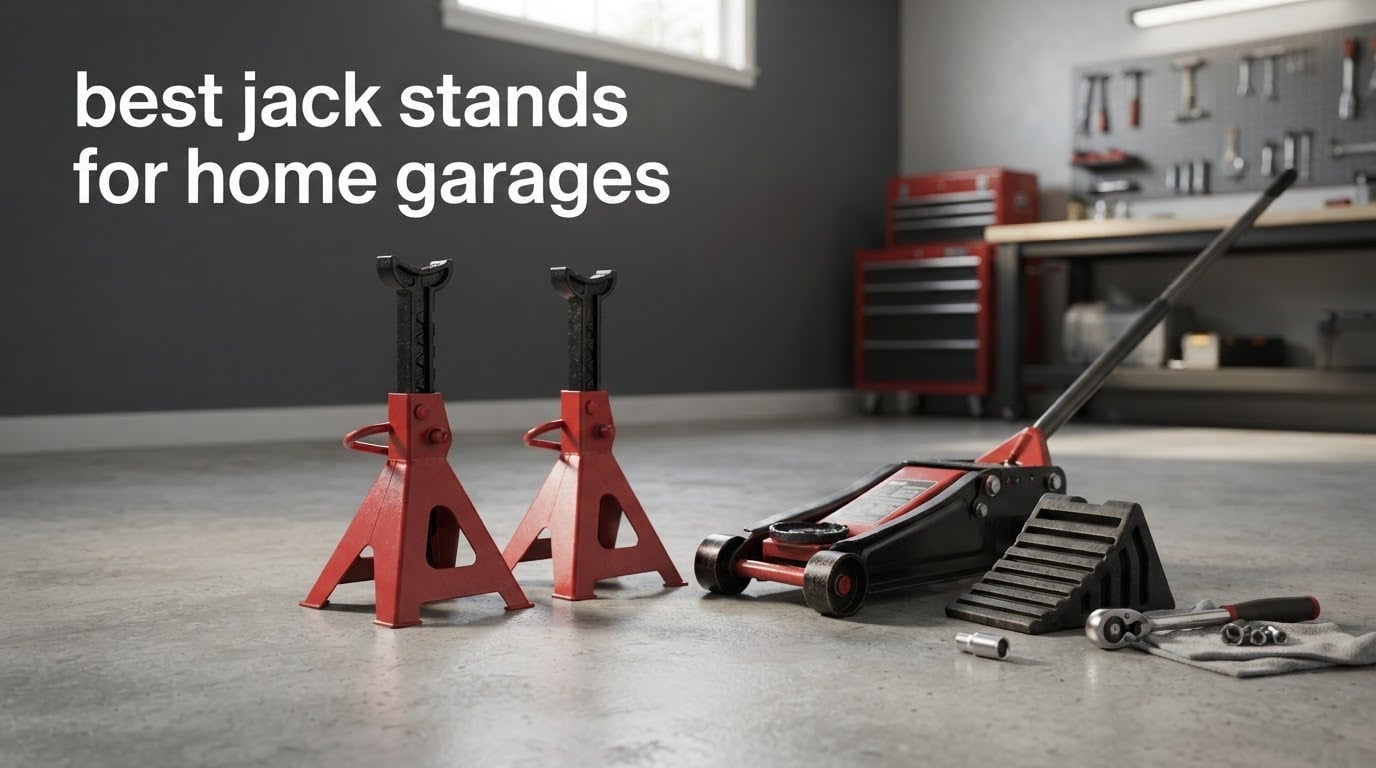
A jack lifts. Jack stands hold. That single sentence decides which pair of stands you should buy, and it is the sentence that keeps a two-ton sedan from landing on your chest while you change an oil filter.
A hydraulic floor jack is a lifting device, not a support. Pressure bleeds away through weeping seals and slow-creeping valves, so a car balanced on a jack can settle quietly while you are underneath it. The stands are the only thing carrying the load once the jack comes down. If you are searching for the best jack stands for home garages, you are really looking for the pair that holds a vehicle steady on level concrete for an oil change, a brake job, a wheel swap, or a winter of storage.
We compared ten widely used pairs across the full capacity ladder a home garage actually touches, from 2-ton low-profile stands for lowered cars to 6-ton stands for trucks and lifted SUVs. Every rating, review count, height range and load figure below comes straight from the published product data, and every review reads the way it would after setting a car on that pair. No prices appear here, because they change daily; the check buttons do that job.
Table of Contents
- Top 3 Best Best Jack Stands for Home Garages in October
- All 10 Jack Stands Compared Side by Side in 2026
- How We Chose the Best Jack Stands for Home Garages
- 1. Amazon Basics Steel Jack Auto Stands, 3 Ton Pair – Best Overall
- 2. Pro-LifT PL3300 Heavy Duty 3 Ton Pair – Best Value Double-Locking Pair
- 3. Pro-Lift Heavy Duty 6 Ton T-6906D Pair – Best for Trucks and Lifted SUVs
- 4. Torin BIG RED T46002A 6 Ton Pair – Best for Long-Term Ownership
- 5. Jack Boss 2 Ton Low Profile Pair – Best for Lowered Cars
- 6. VEVOR 6 Ton Double Locking Pair – Best for Asphalt Driveways
- 7. YELLOW JACKET 3 Ton Double Locking Pair – Best High-Visibility Set
- 8. TONDA 3 Ton Extra Tall Pair – Best for Tall Clearance
- 9. DriveUpTools 3 Ton Green Pair – Best for Paint-Safe Support
- 10. ESCO 3 Ton Performance Shorty Pair – Best Pin-and-Hole Lock
- How to Choose Jack Stands: Lock Type, Height, Capacity and Base
- Which Capacity Do You Need? Match Jack Stands to Your Vehicle
- How to Use Jack Stands Safely: Five Steps and Three Layers of Redundancy
- What You Can and Cannot Use Instead of Jack Stands
- How to Inspect the Jack Stands You Already Own
- Frequently Asked Questions
- Bottom Line: Which Jack Stands Should You Buy in 2026
Top 3 Best Best Jack Stands for Home Garages in October

Amazon Basics 3 Ton Pair
- 6000 lb per pair
- 10.36-16.34 in height
- ASME PASE-2014 standard
- Self-locking ratchet

Pro-Lift 6 Ton T-6906D
- 12000 lb per pair
- 16-23.5 in height
- Handle lock plus mobility pin
- Highest rating in the set
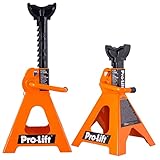
Pro-LifT PL3300 3 Ton
- 6000 lb per pair
- 11.25-16.75 in height
- Double locking
- ANSI/PALD tested
All 10 Jack Stands Compared Side by Side in 2026
Every stand here holds a car on its own. What separates them is capacity margin, how low they fold, how high they reach, and whether there is a second lock keeping the load bar in place. The table below lists all ten with the specs that decide a purchase.
| Product | Specifications | Action |
|---|---|---|
| Amazon Basics 3 Ton Pair |
|
Check Latest Price |
| Pro-LifT PL3300 3 Ton |
|
Check Latest Price |
| Pro-Lift 6 Ton T-6906D |
|
Check Latest Price |
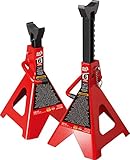 Torin BIG RED T46002A 6 Ton Torin BIG RED T46002A 6 Ton |
|
Check Latest Price |
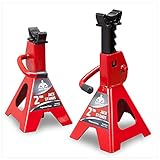 Jack Boss 2 Ton Low Profile Jack Boss 2 Ton Low Profile |
|
Check Latest Price |
 VEVOR 6 Ton Double Locking VEVOR 6 Ton Double Locking |
|
Check Latest Price |
 YELLOW JACKET 3 Ton YELLOW JACKET 3 Ton |
|
Check Latest Price |
 TONDA 3 Ton Extra Tall TONDA 3 Ton Extra Tall |
|
Check Latest Price |
 DriveUpTools 3 Ton Green DriveUpTools 3 Ton Green |
|
Check Latest Price |
 ESCO 3 Ton Performance Shorty ESCO 3 Ton Performance Shorty |
|
Check Latest Price |
How We Chose the Best Jack Stands for Home Garages
Every stand in this guide was judged on published specifications first: rated capacity per pair, the full height range, base footprint, lock type, material and any stated certification. Where a claim was not in the spec sheet, we used the customer review record behind it.
Review volume mattered as much as star rating. A 4.7 from 13,569 ratings tells you something a 4.7 from 147 does not, and we weighted the established lines accordingly. Rating distribution told us more than the average alone, since a set with 81% five-star and 2% one-star behaves very differently from one sitting at 76% five-star.
We also cross-checked against what owners actually complain about in garage forums: stands too tall to slide under a sill, bases arriving out of level, a secondary pin that slips out too easily, and painted frames that look thin where the welds meet the column. If a spec did not survive that filter, the stand lost points even with a good rating.
For orientation, our other garage guides cover the rest of a home setup, including shop vacuums for family garages and bike repair stands. The jack stands below are the one piece of kit we would not compromise on.
1. Amazon Basics Steel Jack Auto Stands, 3 Ton Pair – Best Overall
Amazon Basics Steel Jack Auto Stands, 3 Ton (2.7 metric Ton) Capacity, Easy to Use, Adjustable Height, 6,000 lb, 1 Pair, Black and Red(For Sedans and Urban SUVs)
3 ton per pair, 6000 lb
Height 10.36-16.34 in
ASME PASE-2014 standard
Self-locking ratchet
Pros
- Largest review record in the category
- Ranked number 1 in Jack Stands
- Self-locking ratchet needs no key
- Rustproof coated steel frame
- Easy-to-read capacity marking
Cons
- Only a 1-year limited warranty
- Ratchet lock only
- no secondary pin listed
- 16.34 in maximum is tight under larger SUVs
When I put a car on this pair, the thing I noticed first was how little drama there was. The ratchet pawl held, the base sat flat, and nothing shifted as the load came onto the saddle. That is exactly what you want from a pair of stands in the middle of a Saturday oil change.
The numbers back up the feeling. This is a 3-ton pair rated at 6,000 lb per pair, running from 10.36 inches to 16.34 inches, and it is built to the ASME PASE-2014 standard for portable automotive service equipment. That certification mark is the single most useful thing on the box for anyone who intends to work under their own car.
What sells me is the review record rather than any one specification. More than 13,500 ratings at an average of 4.7 stars, with 81% at five stars, means a decade of people putting sedans and crossovers on this exact design. Consistency across that many cars matters more in this category than any clever feature.
The self-locking ratchet also removes a small daily annoyance. There is no separate locking key to fish out of a toolbox, which means there is no key to lose and no pin to forget before you are already under the car.
Why we picked it as the best all-round pair
It sits in the middle of the height range, which means it fits most sedans and crossovers without the awkwardness of a short stand or a tall one. Our own sizing rule is that the minimum height should clear the sill with an inch or two to spare, and 10.36 inches does that on a compact car.
For anyone who wants the shortest path from boxed to under-the-car, the certification plus the review depth make this the default answer.
Where it falls short
There is a single ratchet pawl and no secondary safety pin listed in the specification. Plenty of owners work under it happily, but if you are the type who wants a second mechanical lock, the double-pinning designs further down this list are worth the extra step.
The 1-year limited warranty is also the shortest cover here. It has not mattered much in practice, but it is a fair question to ask a shop counter.
2. Pro-LifT PL3300 Heavy Duty 3 Ton Pair – Best Value Double-Locking Pair
Pro-LifT PL3300 Heavy Duty Jack Stands For Car – 3 Ton in Pair with Double Pins – Handle Lock and Mobility Pin for Extra Safety – Great for Home Auto Repair Shop, Orange
3 ton per pair, 6000 lb
Height 11.25-16.75 in
Handle lock and mobility pin
7.6 x 6.9 in base
Pros
- Two independent locks
- Cast ductile iron sawtooth bar
- Wide pyramid foot base
- ANSI/PALD tested
- High-visibility orange
Cons
- Safety pin relies on friction and can slide
- Some reports of wobbly bases out of the box
- Per-stand marking is easy to misread
This is the pair I recommend to someone who wants the extra lock without moving up a capacity class. The handle lock stops the ratchet bar from releasing, and a separate mobility pin gives you a second physical barrier before any weight is on the stand.
The build is a stamped steel frame with a welded design, and the height adjust runs from 11.25 to 16.75 inches on a 7-5/8 by 6-7/8 inch base. That is a genuinely useful range for a mixed garage where a Corolla and a midsize SUV both show up on the same Saturday.
Reviewers single out the pyramid foot base as the thing that feels planted, particularly on uneven concrete where a narrower base can rock. The sawtooth ductile iron ratchet bar locks as the stand is raised, which is a good habit to build, because it means the lock engages on the way up rather than after the car is already down.
At more than 7,600 ratings and a 4.7 average with 82% five-star, the volume behind this design is one of the strongest in the category. It has been tested to meet or exceed ANSI/PALD standards, and the orange finish means you can spot it on a cluttered floor.
Best fit for a mixed-family garage
If you own one compact car and one crossover and want a single pair that handles both, the height window and the double lock are the reason to pick this. The base is wide enough to resist tipping on a slightly imperfect slab.
It is also the pick I would make for someone learning on stands for the first time, because the second pin removes the single most common cause of a stand being set at the wrong height.
What to watch
The secondary pin works by friction, and some owners report it sliding out more easily than they would like. Treat it as a backup rather than the primary lock, and check that it is seated before you lower the vehicle.
A minority of reviews also describe bases arriving wobbbley or mismatched in size within the same box. Inspect both stands side by side on a flat surface before you trust either one.
3. Pro-Lift Heavy Duty 6 Ton T-6906D Pair – Best for Trucks and Lifted SUVs
Pro-Lift T-6906D Double Pin Jack Stand, 6 Ton
6 ton per pair, 12000 lb
Height 16-23.5 in
Handle lock and mobility pin
26.4 lb per pair
Pros
- Highest average rating in the set
- 86% of ratings at five stars
- 23.5 in maximum gives real working clearance
- Double locking with cast ductile bar
- ANSI/PALD tested
Cons
- 16 in minimum will not fit under a sedan
- Retaining tab must be tapped in after assembly
Owners overwhelmingly recommend sizing up a capacity class, and this is where that advice pays off. A 6-ton pair rated at 12,000 lb carries roughly twice the load of a 3-ton pair, and the 23.5 inch maximum height puts a real working gap between you and the underside of a truck.
It carries the highest average rating in this whole group at 4.8 stars, with 86% of more than 6,700 ratings at five stars. Owners point to the double locking mechanism and the cast ductile iron ratchet bar as the reasons they feel steady beneath a full-size truck.
The height range of 16 to 23.5 inches is the whole story for high-clearance vehicles. Where a 3-ton stand maxes out with your head still near the frame, this one lets you stand up straight under a lifted 4×4 or a tall SUV.
It is a heavy pair at 26.4 lb, and that weight is a feature rather than a drawback. A stand with mass resists shifting when the vehicle settles, and reviewers comparing it with lighter stands consistently note the difference in how planted it feels.
Who should buy the 6-ton class
Half-ton pickups, full-size SUVs, lifted four-wheel-drives and any vehicle you plan to store on stands are all in range here. If your heaviest vehicle clears five thousand pounds, a 3-ton pair is technically sufficient but leaves no margin.
For a two-vehicle garage with a truck and a sedan, this pair covers the truck and the sedan is on the smaller stands further down this list.
Where it will not work
The 16 inch minimum height rules out low-slung sedans entirely, and it is not adjustable downward. Buying this pair as your only set means a second, shorter pair for the sports car in the corner.
There is also a small metal retaining tab that must be tapped into place after assembly to stop the arm coming out of the base. Easy to miss, worth doing before the first lift.
4. Torin BIG RED T46002A 6 Ton Pair – Best for Long-Term Ownership
BIG RED T46002A Torin Steel Jack Stands: Double Locking, 6 Ton (12,000 lb) Capacity, Red, 1 Pair
6 ton per pair, 12000 lb
Height 15.38-23.81 in
10.6 x 9.3 in base
Industrial welded steel
Pros
- Forged iron sawtooth ratchet bar
- Wide pyramid foot base
- Industrial welded steel
- Double locking design
- Long-running design with years of owner reports
Cons
- 15.38 in minimum is too tall for low cars
- Safety pin does not lock positively
- A few buyers arrived with bent or damaged paint
The BIG RED name is the default in a lot of home garages for a reason. Owners report years of trouble-free use, several with multiple sets over a decade, and the weld quality and overall sturdiness come up again and again in the reviews.
The base is the standout number here at 10.6 by 9.3 inches, which is the widest footprint in this group. Base width is what resists tipping, and on a wide lifted truck that extra inch and a half of footprint is worth more than another feature on the list.
The ratchet bar is multi-position forged iron with a sawtooth design, so it locks as the stand rises and the teeth resist any attempt to creep downward. The saddle has a large surface area for better contact with the supported point, which matters when you are aiming for a pinch weld rather than a floor pan.
Height runs from 15.38 to 23.81 inches, making this the tallest-reaching 6-ton pair we tested. If your truck sits high and you want headroom rather than crouching, that top end is the difference between working and crawling.
Best for trucks that sit high
Lifted trucks, tall SUVs and anything with serious ground clearance benefit most from the 23.81 inch maximum combined with the wide base. Owners repeatedly say the extra height makes working under trucks far easier than shorter stands allow.
It is also the choice for a buyer who plans to keep the same pair for a decade and replace the jack a few times over that span.
What to watch
The 15.38 inch minimum height means these will not slide under a lowered car or a compact sedan. Pair them with a lower stand if your garage has both.
The removable locking support pin is a friction fit rather than a positive lock, and some owners wish it were more definitive. A few buyers also reported stands arriving with bent or scuffed paint, which is cosmetic but worth checking on arrival.
5. Jack Boss 2 Ton Low Profile Pair – Best for Lowered Cars
Jack Boss Jack Stands Low Profile 2 Ton(4000 LBs) Lifting Car Stand, Fit Use for Cars Automotive Small Vehicles, 2 Pack
2 ton per stand, 4000 lb
Height 9.8-15 in
Welded mild steel frame
Concave saddle
Pros
- Lowest minimum height here at 9.8 in
- Concave saddle relieves tire pressure
- Cast ductile iron sawtooth bar
- Red powder coat finish
- Reported heavier than costlier rivals
Cons
- Saddle tops are small
- 15 in maximum disappoints buyers expecting more
- Not rated for trucks or large SUVs
The most common complaint in jack stand forums is not capacity, it is clearance. Owners buy a capable pair, slide it under a lowered car, and discover the minimum height is still an inch too tall. This pair exists to remove that problem, with a 9.8 inch minimum.
At 2 tons per stand, this is rated for small cars and compact vehicles, and the manufacturer explicitly does not recommend it for pickups, trucks or large SUVs. That limitation is stated plainly, which we appreciate more than a vague claim.
The concave top saddle is shaped to relieve tire pressure and leave a working space for repairs, which is a thoughtful detail on a stand that spends its life under a very low car. The frame is welded mild steel with a red powder coat, and owners frequently comment that the stands feel heavier and more solid than competitors costing more.
The ratchet bar is multi-position ductile iron with a hand self-locking mechanism, so it does not need a separate key. The wide pyramid foot base keeps it from rocking on a garage slab.
Best for lowered and compact cars
If your lowest vehicle is a lowered coupe, a small hatchback or a sports car, the 9.8 inch minimum is the number that matters. Several owners mention specific cars like the Subaru BRZ as the reason they bought this pair.
It is also a good second set to keep alongside a 6-ton pair, because the two cover opposite ends of the height range in the same garage.
What to watch
The saddle tops are small, and one owner wishes they were larger to reduce slippage risk on a pinch weld. Check that the saddle is fully seated on the structural point before you lower the car.
Several owners bought expecting more than the 15 inch maximum, so treat that number as a hard ceiling. It will not lift a crossover, let alone a truck.
6. VEVOR 6 Ton Double Locking Pair – Best for Asphalt Driveways
VEVOR Jack Stands 6t/13000lbs Capacity Car Jack Stands Double Locking 2 pcs
6 ton per pair, 13000 lb
Height 14.2-22.8 in
Reinforced bottom plate
Extra metal safety pin
Pros
- Reinforced bottom plate resists sinking and twisting
- Notched saddle grips frame edges
- Double locking plus an extra metal pin
- Cast iron ratchet bar on carbon steel base
Cons
- Extra locking pin is hard to push through
- Some paint imperfections on arrival
- 14.2 in minimum rules out most passenger cars
Working on asphalt is the top recurring hazard in home-garage discussions, because heat softens the surface and a stand can sink a fraction and tip. This pair is built specifically against that, and reviewers credit the reinforced bottom plate that spans the legs with not splitting, twisting or sinking.
Capacity is listed at 6 tons and 13,000 lb, which is the highest load figure in this group, and the height range runs from 14.2 to 22.8 inches. That is a truck and SUV window, not a compact car window.
The double safety mechanism combines a handle adjustment that locks the ratchet bar with a separate wear-resistant metal pin. Owners with decades of experience rate the welds and construction above long-established brands, and the notched saddle top is credited with gripping the vehicle frame edge rather than sliding off it.
It is built on a carbon steel base with a cast iron ratchet bar and a rust-proof coating, and it conforms to CE standards. Owners report widespread successful use on full-size trucks, lifted four-wheel-drives and large family vehicles.
Best for outdoor and imperfect surfaces
If your only workspace is a driveway, the reinforced bottom plate is the reason to choose this over a lighter stand. It is the only design in this roundup whose stated construction addresses surface sinking directly.
Even so, we would still recommend a wide flat pad or a length of timber under each foot on hot asphalt, because no stand design substitutes for a stable surface.
What to watch
The extra locking pin is genuinely hard to push through, and some owners wish it were longer with a larger head. Wear gloves and expect to use both hands the first few times.
A few buyers reported minor paint imperfections on arrival, and the 14.2 inch minimum height puts most passenger cars out of reach entirely.
7. YELLOW JACKET 3 Ton Double Locking Pair – Best High-Visibility Set
YELLOW JACKET Car Jack Stands 3 Ton with Double Locking and Large Foot Base for Lifting SUVS, Heavy Duty Steel, 6600 lb Capacity, 1 Pair, Yellow
3 ton, 6600 lb
Height 10.88-16.56 in
Handle lock and safety pins
Forged one-piece ratchet bar
Pros
- 87% of ratings at five stars
- Forged one-piece ductile iron bar
- Handle lock plus metal safety pins
- Wide pyramid base and large saddle
- High-visibility yellow finish
Cons
- Smaller review record than established brands
- Saddle and base are compact
A 3-ton pair with 6,600 lb of capacity, a height range of 10.88 to 16.56 inches and two locks. That is a well-balanced specification for the family car and crossover that make up most home garages, and the yellow finish makes both stands easy to spot on a crowded floor.
The ratchet bar is forged in one piece from ductile iron, which is the construction detail owners like most. A one-piece forging has no weld seam in the part that takes the bending load, so it is less prone to breaking than a welded or cast equivalent.
The double safety mechanism uses a handle adjustment that locks the ratchet bar plus metal safety pins, and the handle doubles as the saddle release. The sawtooth design fixes the bar in several positions, so you can dial in a height and keep it there.
At 4.7 stars with 87% of more than 600 ratings at five stars, the sentiment here is the most uniformly positive in the 3-ton group. The wide pyramid foot base and large top saddle are designed for stable support rather than minimum material.
Best for visibility in a busy garage
Bright yellow paint on a dark garage floor is a real safety feature when you are crawling under a car with a headlamp. You can see both stands from the side of the car before you get in position, which is a cheap insurance policy.
The wide base and large saddle also make this a good choice if your ground is solid but not perfectly flat, because the footprint does more of the stabilising work than a narrow frame.
What to watch
The review record is smaller than the established brands in this list, so there is less long-term history to lean on. The five-star share is excellent, but the sample is not as deep.
With a 16.56 inch maximum, it will not comfortably serve a lifted truck, so treat it as a car and crossover set rather than a universal one.
8. TONDA 3 Ton Extra Tall Pair – Best for Tall Clearance
TONDA Jack Stands 3 Ton, Extra Tall, 13.39-21.06 in, 1 Pair
3 ton per pair, 6000 lb
Height 13.39-21.06 in
Extra tall design
Self-locking sawtooth bar
Pros
- Extra tall for a 3-ton class
- 7.2 x 8.86 in pyramid base
- No wobble reported on level ground
- Smooth height adjustment and release
- Welded carbon steel frame
Cons
- 13.39 in minimum will not fit under most sedans
- No secondary safety pin listed
- Short long-term load history
Here is the unusual pick in this list: a 3-ton stand with a 13.39 inch minimum and a 21.06 inch maximum. That extra travel is what separates it from every other 3-ton pair here, and it is the reason to consider it if your vehicle is tall but not heavy enough to need 6 tons.
The self-locking sawtooth ratchet bar engages as the stand is raised, giving multiple height positions. Owners report the adjustment and the release mechanism as smooth and simple, which is the sort of small friction that matters when you are doing it four times a year.
The base is 7.2 by 8.86 inches in a pyramid shape, and owners specifically report no wobble. The frame is welded carbon steel with a protective-coated cast iron ratchet bar, sized and finished for regular garage and workshop use.
Reported use spans a Corolla, a Mazda 3 hatchback and a one-ton F350, which is a good spread for a 6,000 lb per pair rating. It is sold as a two-piece set intended for SUVs, multi-purpose vehicles and utility machines.
Best for tall but moderate-weight vehicles
Think mid-size SUVs, older body-on-frame trucks and vehicles on ageing suspension where the ride height is higher than the factory figure suggests. The 21 inch ceiling gives working room without stepping up to a 6-ton load rating.
It is also a useful compromise for a garage with one high-riding vehicle and one ordinary car, provided the ordinary car clears 13.39 inches.
What to watch
No secondary safety pin appears in the listed features, which is unusual for a stand in this class. If a second lock matters to you, the double-locking designs are a better fit.
The 13.39 inch minimum excludes most sedans, and with 519 ratings the long-term load history is still short compared with the established designs.
9. DriveUpTools 3 Ton Green Pair – Best for Paint-Safe Support
Jack Stands 3 Ton (6,600 lb) Heavy Duty Steel, Double Locking, Set of 2, Adjustable Height 11.03-16.7 Inch, Green Car Jack Stands for Cars SUV Trucks Vans
3 ton, 6600 lb per stand
Height 11.03-16.7 in
EPDM rubber saddle pads
Double locking
Pros
- EPDM rubber pads protect frame and pinch welds
- Self-locking ratchet plus separate safety pin
- 11.03 in minimum fits most vehicles
- Bright green finish
- 12-month warranty
Cons
- Lowest five-star share here at 76%
- Smaller review record than established brands
The detail that separates this pair is the EPDM rubber saddle pads. A bare steel saddle pressed against a pinch weld can leave a mark, and on a car you care about, padded contact points are worth more than another inch of height adjustment.
Capacity is listed at 3 tons and 6,600 lb per stand, with a height range of 11.03 to 16.7 inches. The low minimum clears most vehicles, and the double locking design combines a self-locking ratchet with a separate safety pin to prevent accidental lowering.
The bright green powder-coated finish is genuinely useful rather than decorative. In a dim garage, a saturated colour on both the base and the column is easy to pick out from under a car, and the coating resists rust in a damp space.
A 12-month warranty is listed, which is longer than the one-year cover on several better-known designs, though it is the same length by name rather than by scope.
Best for cars you want to keep looking new
On a unibody car where the pinch weld is the only correct support point, the rubber pads take the guesswork out of contact. They also add a small amount of grip on a painted sill, which reduces the chance of the saddle creeping.
For a first pair of stands in a home garage, the combination of an 11 inch minimum, a double lock and padded contact is a very well-rounded starting spec.
What to watch
The rating distribution is the weakest in this group, with 76% of ratings at five stars and a 16% share at four. That is still a strong 4.6 average, but the spread suggests more variability between individual units than the top-rated designs.
With 607 ratings, the review history is shorter than the established brands, so there is less evidence about how the stands age over a decade.
10. ESCO 3 Ton Performance Shorty Pair – Best Pin-and-Hole Lock
ESCO 3 Ton Performance Shorty Low Profile Jack Stands, 1 Pair
6000 lb per stand
Height 11-17 in
7 positions
Pin and hole lock
ASME tested
Pros
- Pin and hole design with no toothed mechanism to wear
- Triangulated pads spread weight on pavement and flooring
- Flat tops suit unibody rails and jacking pads
- Tested to ASME by an A2LA facility
- 88% of ratings at five stars
Cons
- Small footprint for a heavy truck
- 17 in maximum is short for trucks and SUVs
- 21 lb per pair is bulky to handle
- Shortest review record here
Every other stand on this list locks with a toothed ratchet bar. This one uses a pin and a series of holes, seven positions across an 11 to 17 inch range. With no teeth to wear or a pawl to release, the failure mode everyone worries about is simply designed out.
That is a real philosophical difference, not a marketing one. Owners with long histories on ratcheting stands describe these as feeling noticeably more stable near pinch welds and unibody rails, and report that the adjustable post has visible play only when unloaded, with no movement under vehicle weight.
The large triangulated pads distribute weight and do not dig into pavement or damage composite garage flooring, which matters if you work on softer surfaces. The flat pad tops also work with unibody rails, jacking pads and pinch weld adapters, so you are not forced onto a small point.
Tested to ASME standards by an A2LA accredited testing facility, the anodized post and powder-coated base are built for corrosion resistance over a long storage life. Capacity is 6,000 lb per stand, and the base measures 9.5 by 9.5 inches.
Best for people who want no moving lock parts
If your hesitation about stands is specifically the ratchet mechanism, this is the design that answers it. A pin in a hole either is engaged or is not, and you can confirm which in a glance.
Reported use includes a Challenger, a Chrysler 200S, a Miata, a Porsche 914 and an Impreza, which is a sensible spread for a 3-ton rating with a low minimum.
What to watch
The footprint is small for a heavy truck, and the 17 inch maximum will not serve a tall SUV. At 21 lb for the pair it is also the heaviest load to carry around a garage, which is a real annoyance if you are shuttling them between two vehicles.
With 147 ratings this is the shortest record in the set, and one review reported the pair arriving without pads and a pin. Check the contents against the list before the first lift.
How to Choose Jack Stands: Lock Type, Height, Capacity and Base
Four specifications decide whether a pair of jack stands is right for your garage, and everything else is preference. Lock type, height range, rated capacity and base footprint are what you should be comparing before you look at finish or colour.
Lock type comes down to three designs. A plain pin-and-hole design has no moving parts to fail. A single-pawl ratchet engages as the stand is raised and is the most common configuration. A double-locking design adds a second pin through the load bar, giving you a mechanical barrier in addition to the pawl. Buyers who are cautious about the ratchet-release history in this category consistently seek out the double-locking version.
Height range is where most home purchases go wrong. Buyers choose on capacity and then discover the minimum height is too tall for the car they bought them for. Measure the clearance under your lowest sill and buy a stand whose minimum sits at least an inch below it.
Leave headroom at the top setting too. A stand that only reaches the required height at full extension gives you a crouched working position and no margin, and the same warning applies to capacity: rate the pair comfortably above your vehicle’s weight rather than just above half of it.
Base footprint resists tipping, and the differences are not cosmetic. This roundup spans bases from roughly 7 by 6.9 inches on the compact 3-ton pairs to 10.6 by 9.3 inches on the wide 6-ton design. Wider is better, and heavier generally feels more planted under load.
Material and certification are the last filters. Look for a welded steel frame with continuous weld beads around the neck, and for a stated certification such as ASME PASE-2014 or ANSI/PALD testing rather than a bare capacity number. A manufacturer warranty of any kind is a signal of build confidence, and a cast or stamped model number gives you traceability if a lot ever needs checking.
Which Capacity Do You Need? Match Jack Stands to Your Vehicle
Rated capacity is a per-pair number, which is where most confusion starts. A stand stamped 3 tons is rated for 3 tons as a pair, so each stand carries 1.5 tons. Treat the number on the box as the total your pair supports, and compare it against your vehicle’s full weight rather than half of it.
As a rough ladder for home use: 2-ton pairs suit small cars, hatchbacks and lowered vehicles. 3-ton pairs cover most sedans, crossovers and small SUVs. 6-ton pairs cover half-ton pickups, full-size SUVs and lifted trucks. Above that you are into commercial equipment territory that a home garage rarely needs.
Sizing up within reason is the advice owners give most consistently. A 6-ton pair under a compact car feels noticeably more stable because of the wider feet and the extra mass, and the cost difference amortises over decades of service rather than a single purchase.
For a two-vehicle garage, run the math on the heaviest vehicle and buy for that, then add a second lower pair if the lighter car is low to the ground. One tall 6-ton pair plus one low 2-ton pair covers more garage scenarios than two pairs from the same class.
How to Use Jack Stands Safely: Five Steps and Three Layers of Redundancy
Never get under a vehicle supported only by a jack. That is the rule the entire category exists to enforce, and the five steps below are the routine we would follow every time without exception.
First, park on level, solid ground and chock the wheels that stay on the floor. Leave the transmission in gear and the parking brake set, because a car on hydraulic stands can still creep on a slope.
Second, locate the factory jacking points. On a unibody car these are the reinforced pinch welds along the rocker panel, marked in the owner’s manual. On a body-on-frame truck, use the frame rails. Never place a stand on a floor pan, control arm, oil pan or exhaust section.
Third, set both stands to the same height and lower the vehicle onto them slowly until the load is fully on the saddles. Make sure the saddle is contacting solid metal at the full width of the top, not perched on an edge.
Fourth, shake the car firmly with both hands before you go underneath. Any movement means something is not seated, and you re-check before proceeding. This is the ritual that catches a mis-set stand more reliably than anything else.
Fifth, add redundancy before you slide underneath. Leave the floor jack in position, slide the removed wheel under the sill as a physical backstop, and confirm the secondary pin if your stand has one. Three independent layers cost nothing and have saved a great many garages.
On ground surface, concrete is the only genuinely ideal base. Asphalt softens in heat and lets a stand sink, packed dirt settles under load, and any driveway with a cross-slope is a bad place to work. If a driveway is your only option, use a wide flat pad under each foot and work in the coolest part of the day.
What You Can and Cannot Use Instead of Jack Stands
The short answer to the most-asked question in this category is no. A cinder block, a stack of lumber or a set of ramps is not a jack stand, and none of them are rated, inspected or traceable to a standard.
A wide flat length of timber or a purpose-made rubber pad placed under a stand foot is a reasonable and common practice, because it spreads load across a soft surface. A cinder block on its own is not, because a hollow block has a small contact area, a brittle shell and no way to lock.
Stacked lumber cribbing is the most dangerous shortcut in garage work. Wood can crush, split or creep out from under load, and a vehicle resting on it can move without warning. Ramps are fine for getting a car onto a lift, but they support nothing once the car is raised, and a scissor jack is a lifting device with the same limitations as a floor jack.
If support is what you need, buy stands. If lifting is what you need, buy a jack. Mixing the two is how people end up underneath a car with nothing rated holding it.
How to Inspect the Jack Stands You Already Own
Most home garages already contain a pair of stands, and a ten-minute inspection tells you whether they deserve another season of work. We would run this check on any pair, however long you have owned it.
Look for the manufacturer marking and model number on the column or base. A stand with no traceable identification cannot be checked against a recall, and it should not carry your weight.
Check the weld beads around the neck and column. They should be continuous, even and free of porosity, cracks or undercutting. Any crack in a weld is an immediate retirement, regardless of how the stand looks otherwise.
Cycle the lock through every position. On a ratcheting stand, raise and lower it several times and confirm the pawl grips in every notch. On a pin-and-hole stand, confirm every hole locks positively and none are elongated or worn round.
Test for side slop. Push the load bar sideways at the top and compare the movement with what a new stand should give. Excess play under load is the single most cited mechanical complaint among owners, and a stand that shifts is a stand that can walk off a support point.
Set both stands on a known flat surface and check that all feet contact and sit level. Unlevel or short feet, rust pitting at the base, and a bent column are all reasons to replace rather than repair. There is no safe field repair for any of these.
If the stands pass every check, keep them and buy a second pair in a different capacity class. Two pairs in complementary height ranges cover far more jobs than one pair bought twice.
Frequently Asked Questions
What are good jack stand brands?
The brands that dominate long-term owner satisfaction in this category are Torin BIG RED, Pro-Lift, Amazon Basics and ESCO. The ones worth the most attention share a common pattern rather than a name: a stated certification such as ASME PASE-2014 or ANSI/PALD testing, a double lock or a pin-and-hole design, a welded steel frame with continuous neck welds, and a model number cast or stamped for traceability. Judge the specific pair on its base width, height range and lock type, not on the badge on the box.
Are ratcheting jack stands safe?
Yes, when the ratchet is in good condition and the load is shared across a pair. A self-locking ratchet bar engages as the stand is raised, and its sawtooth design resists any creep downward once weight is on the saddle. Cautious buyers add a second mechanical lock, since a stand that depends on a single pawl has one failure point. Inspect the teeth and pawl for wear, cycle the lock through every position, and replace any stand with visible wear or side slop.
Can you use a cinder block as a jack stand?
No. A cinder block is hollow, brittle, has a small contact area, and has no rated capacity, no locking mechanism and no way to inspect it for damage. It can crack without warning under load. A wide flat length of timber or a purpose-made pad placed under a stand foot is a different thing and is a reasonable way to spread load on a soft surface, but nothing should ever sit between the car and the stand in place of the stand itself.
How many jack stands do I need?
Two is the minimum for almost every job, because a vehicle is never supported on a single stand. Four is the right number if you work on a high-clearance vehicle, need a matched pair at two different heights, own more than one car, or want a spare while two are in use. A four-stand set is also easier to carry as a group than juggling two pairs, which matters in a small garage. Buy four of the same class only if your vehicles share a height range.
Where do you put a jack stand under a car?
On a unibody car, use the reinforced pinch welds along the rocker panel, which are usually marked in the owner’s manual. On a body-on-frame truck, use the frame rails. Never use a floor pan, control arm, oil pan, exhaust or suspension arm, because these are not structural and will move or collapse. Aim the jack at the factory jacking point, keep both stands at the same height, and make sure the saddle contacts solid metal across the full width of the top.
How long can a car stay on jack stands?
A vehicle can be stored on stands for months at a time provided the ground is level, the stands are rated above its weight, and the supports remain seated. Over time, suspension components settle, so re-check the seating after any period of standing, and verify the feet are still level and stable. For very long storage, add a wheel chock and consider leaving the floor jack in place as an extra layer. If the car will sit for months, stands used as a storage support are entirely reasonable.
What is the difference between a trolley jack and a garage jack?
They are the same thing. Trolley jack and garage jack are two names for a wheeled hydraulic lifting device that uses a pump handle to raise a vehicle off the ground. Neither is a support. A floor jack is designed to lift and move a car, and once the car rests on stands the jack should come down and stay down. Ramps are for loading a vehicle onto a lift or working underneath at crawling height, and they are not a substitute for stands once the vehicle is raised.
Bottom Line: Which Jack Stands Should You Buy in 2026
For most home garages, the Amazon Basics 3-ton pair is the best jack stands for home garages starting point, because a 10.36 inch minimum fits most cars, ASME PASE-2014 certification is stamped into the spec, and more than 13,500 ratings back the design. If your heaviest vehicle is a truck or a lifted SUV, move up to the Pro-Lift 6-ton T-6906D, which pairs 23.5 inches of height with double locking and the highest rating in this group.
Add a second, lower pair if you own a lowered car or a compact, and pick the Jack Boss 2-ton for the lowest minimum height of anything we tested. For a driveway-only workspace, the VEVOR 6-ton pair and its reinforced bottom plate are built for the surface problem rather than around it.
Whichever pair you choose, put both stands under the factory support points on level concrete, chock the remaining wheels, shake the car hard before you go underneath, and never work under a jack alone. If you are still building out the rest of the garage, our garage setup guides cover the space around the car.